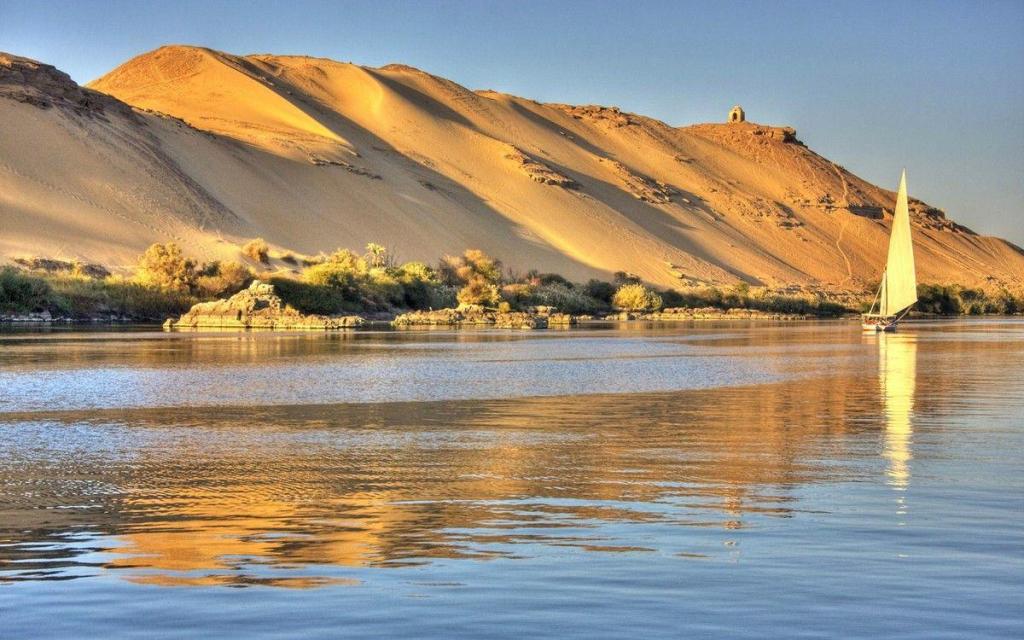
I recently took the Viking’s Nile River Cruise to visit Egypt. Many of my friends have asked me to narrate my views on this country, which I’ll share below.
The capital Cairo has a population of 23.1M. Its overpopulation becomes evident in the traffic patterns of the city. It’s common to have a third car drive in-between two cars at high speeds — which results in a very unsafe habit as well as many dented car doors. Traffic congestions are common at all hours of the day.
Temperatures ranged from 103 to 105 degrees Fahrenheit during my June 2-14, 2025 stay — with no rain. While the air was dry – as compared to the humidity prevalent in the Tampa Bay Area where I live – these high temperatures required tourists to wear sun screen, hats, and sun glasses daily while venturing out. Staying hydrated was a must.
While neighborhoods near the airport – like Heliopolis – were beautiful and modern, other areas left a lot to be desired. Egyptian President al-Sisi issued an edit recently requiring homes near major thoroughfares to be freshly painted. But this edict represented only a half-measure, as many homeowners leave their buildings and homes unfinished with rebars exposed at the top in order to not pay excessive taxes to the government. This practice gives Cairo a very unpleasant look.
Abortion is unlawful in Egypt except when done to protect the life of the mother.
LGBTQ is also illegal, and those who come out are subject to stiff jail sentences.
85% of the population is Sunni Muslim, with 15% being Coptic Orthodox Christians.
Polygamy is still legal in Egypt. Islamic law allows men to have up to four wives – provided that he can afford them and treat them equally. Nevertheless, because of the rise of women’s rights and high cost of living less than 1% of Egyptian Muslim men practice it.
In ancient Egypt, most men were monogamous except the pharaohs — who had multiple wives and concubines. The word “queen” was given to the “King’s Wife” – who would be featured in official records and religious ceremonies. The expectation was that she would become the “King’s Mother” after producing an heir. If she failed in this task, another lesser wife might receive the title.
Sunni Muslim women typically wear the abaya, a black body covering, and the shayla, a black scarf covering their heads. Men wear the galabeya, an ankle-length loose-fitting garment.
The Coptic Orthodox Church emphasizes that its followers should focus on their internal character rather than on their outward appearance. Dress attire should be modest in church and secular life – with proper covering of the arms as well as long pants covering the legs. It’s easy to identify Coptic Christian women as they don’t wear any head covers.
Shopping is quite an experience. The City Stars Mall is connected to the Intercontinental Cairo Citystars Hotel, where I stayed. This is a beautiful mall with all the amenities that you would find in a western shopping mall. I purchased several linen shirts and a pant at one of the stores at great prices.
The current exchange rate is 50 Egyptian pounds equal one dollar. Vendors preferred the U.S. dollars, so there is no need to purchase any Egyptian currencies. 10% gratuity is the accepted rate at restaurants.
Local shopping is an experience that most westerners are not used to – as vendors are used to selling their wares in a way that can be intimidating and bordering on bullying. Rather than attracting customers to the shops, these selling practices have the opposite effect. Never accept the first prize for an item and always negotiate for a lower price.
I had a very unpleasant experience when purchasing a galabeya at a market in Esna – a city on the west bank of the Nile River and near Luxor. When I saw one that I liked, I went inside the shop to negotiate the price. The vendor insisted in having me wear the 2-piece galabeya and a turban. When I asked for the price for the ensemble, he quoted me $85. When I told him that I was unwilling to pay that price and proceeded to take off the garment and turban, he would not let me. When my wife saw the dilemma that I was in, she walked to the shop and demanded that the vendor let me go as I was not interested in the items. When she yelled at him, he gave in. Once outside, he followed us and apologized for his rudeness — and proceeded to bring down the price from the original $85 to $10. When I agreed to the latest price and gave him $10, he wanted to give me only one piece – not the original 2 pieces. I needed my wife’s help again who grabbed the second piece from his hands, and we completed the sales transaction. It was not a pleasant experience at all.
I encountered another surprising incident when visiting a Nubian village in the Aswan region in southern Egypt. Scheduled in our Viking itinerary was a visit to an elementary school. My wife had prepared bags with school supplies to give out to the students. Arriving at the school, we were told that classes were canceled – probably because of the high temperatures. The tour guide suggested to give out the bags to the children when we visited other villages. When disembarking at Kom Ombo, my wife ran into a multitude of children, and she handed out school bags to some of them. The word “some” could be defined as including approximately ten children. In a matter of seconds, she was surrounded by a large crowd of adults who demanded that my wife give them school bags for their kids. Some must have confused my wife with being Italian, as they claimed to have three “bambinos.” My wife was resolute in telling them that the bags were only for the children, but they would not listen and started to get aggressive. At this juncture, the tour guide and I had to stretch out our arms and tell everyone to back off. It was certainly a scary moment. I learned that when visiting Egypt, it takes a “village” to stay safe!
Middle class families have an average of 2 children, while poor families range from 4 to 5 children. Contraceptives are highly encouraged for population-control purposes, but poor parents view children as workers to increase the family finances.
With the Egyptian population at 118M and growing, this presents a challenge for a country where water and jobs are scarce – plus schools and hospitals are overcrowded. President al-Sisi indicated that two of the biggest threats facing Egypt are terrorism and population growth.
One of the world leaders whom I admire that most was the late Egyptian President Anwar Sadat – who was assassinated on October 6, 1981 by members of the Egyptian Islamic Jihad (a terrorist group that allied itself with the al-Qaeda network in the 1990s). The main reason for the assassination was the signing of the Camp David Accords between Egypt and Israel. Sadat was an extraordinary statesman of great vision and guts, and Egypt honors his memory with his burial site at the Unknown Soldier Memorial in one of Cairo’s main thoroughfares. The inscription on his grave reads: “The hero of war and peace.” I was able to pay my respects to Sadat by asking the bus driver to stop the bus in front of the memorial to say a prayer and take a photo.
Jehan Sadat, the wife of the President Sadat, also played an important role in reforming Egypt’s civil rights during the late 1970’s in a patriarchal society. The Jehan’s Laws granted women many new rights – including those pertaining to alimony and custody of children in the event of divorce.
According to the Saint Augustine of Hippo, an early Christian theologist and philosopher, “the world is a book, and those who do not travel read only one page.” There are some who dispute the origin of this quote to Saint Augustine, but I’m not going to get into this polemic as it’s the meaning of the quote that matters.
When comparing the 249 old history of the United States to the Egyptian civilization that historians dates back to 3150 BC, it is obvious that Americans have a lot to learn by visiting Egypt.
 Jorge E. Ponce
well written! Thanks for sharing
LikeLike