SOME INCIDENTS IN MY TRAJECTORY AS A CUBAN REFUGEE / by Jorge E. Ponce

The trajectory of a refugee is one of embracing other cultures while never forgetting the one where you come from.  It could be painful at times but often life doesn’t offer many viable choices.  

With fifty-nine years living in the United States, I’d like to offer four incidents that caused me to stop and think deeply about how to respond politely and adequately to each.

The first one deals with my Ponce surname.  Some people assume automatically that I am Puerto Rican — as Ponce is one of the most important cities in this Caribbean Island.  Ponceños think so highly of their city that their motto is “Ponce es Ponce y lo demas es parking” or “Ponce is Ponce and all other cities in Puerto Rico don’t measure up.” The city was founded in 1692 and is named after Juan Ponce de León y Loayza, the great grandson of Spanish conquistator Juan Ponce de León.

To the great surprise of many when I clarify that I am Cuban American, they learn that there are Ponces of all nationalities.  But let’s get a reality check.  If you gathered all the Ponces throughout the world in the city of Ponce, Puerto Rico, this metropolis would become the center of attention of the entire world.  No one could bring together so much talent to one place! Just kidding!

Others asked me if I’m related to the Spanish conquistador Juan Ponce de León.  There are all kinds of insinuations about this question – one of which is that for me to be treated like a VIP in the world, I have to be related to the Spanish royalty.  A Cuban-American, a denizen from a Caribbean Island – even one that Christopher Columbus described in 1492 as “the most beautiful land that human eyes have ever seen” — does not deserve the top scores in these people’s scorecards. 

Those who underestimate Cuban Americans have no clue about the grit, determination, and successes of so many of us who have achieved the rewards that the American Dream has to offer.  Just think of two outstanding Cubanos in American society nowadays: U.S. Secretary of State Marco Rubio and the 2025 recipient of the Heisman Trophy, Fernando Mendoza.

But let’s followed up with a history lesson regarding the Spanish conquistador and the country Spain.  After the Christian armies recaptured territories from the Muslims that had occupied Spain since 711 AD, multiple Christian kingdoms emerged like Castile and Aragon.  An important milestone for the unification of Spain was the marriage in 1469 between King Ferdinand of Aragon and Queen Isabella of Castile.  An even more important event was the conquest of Granada in 1492 – the last Muslim stronghold in the Iberian Peninsula and which played a pivotal role in the unification of the country. 

So, the “de León” in the Spanish Conquistador’s Ponce surname was indicative that this family came from the Kingdom of León before the reunification of Spain.  It pertains to a geographic region and has nothing to do with one’s genealogy.  It is very possible that I may be related to this Spanish conquistador’s family – as Ponce is not a common surname.  But I’m not losing any sleep over it. 

To make it easier to those who want to place such an important value to my ethnicity, I often refer to myself as: “Jorge Ponce de La Habana” – by birthplace.

Upon finding out where I come from, many want to display their pseudo erudition by asking whether I have gone back to Cuba.  I quickly respond that I would never set foot on a communist gulag that my family fled from, and that has continued to oppress the Cuba people for sixty-six years.  I clarify that I will only go back when I am able to drink a Cuba Libre with authentic Cuban American Bacardi Rum in a Cuba that is really Libre – in a Cuba that has replaced the Communist motto of “Patria y Muerte” (“Country or Death”) with a more Christian alternative of “Patria, Vida, y Libertad” (“Country, Life, and Freedom”).

But most are done with me yet.  When they see my name spelled on multiple forms as “Jorge,” they proceed to call me “George.” If my mother would have wanted me to name me “George,” she would have done so.  The pronunciation of Jorge as “horhe” does not even come close to the pronunciation of “George.”  With the U.S. population in 2025 made up of 68 million (20%) Hispanics, I would have thought that many would run across many “Jorge’s” in their business dealings by now.  Popular American Writer Dale Carnegie in his magnum opus book “How to Win Friends and Influence People” reminded his readers that “a person’s name is, to that person, the sweetest and most important sound in any language.” Mr. Carnegie realized that it was not just the correct spelling of a person’s name that mattered, but its pronunciation as well.

And the last question is one that I’ve asked myself repeatedly.  How to respond when people ask me where do I come from.  In the past, I’ve responded by calling myself a Cuban American.  But when I’ve traveled overseas and I’ve responded this way, people confused my allegiance to the communist government in Cuba.  And rather than enjoying the now, this triggered an adrenalin boost of negative energy – which is totally unnecessary for good health and to seize the joyous moments that life offers us.  Therefore, I’ve made an adjustment. 

Cuba will always be a part of me, of my personality, of my way of thinking.  But the Cuba that I keep in my soul and the one that I toast to when I order a Cuba Libre is the Cuba BC (Before Castro).  I share nothing in common with the Cuba DC (During Castro) and Cuba AC (After Castro).

When this situation comes up again, I’ll respond that I am “an American of Cuban descent.”  

ILLEGAL IMMIGRATION / Jorge E. Ponce

Andres Oppenheimer challenged, in a December 3rd op-ed, the current immigration policies of President Trump.  His one-sided arguments merit a more impartial rebuttal.

While I submitted a letter to the editor to the Miami Herald and El Nuevo Herald, where Andre’s op-ed was published, my letter was ignored.  I was not surprised given the liberal ideological orientation of both newspapers in a city that just elected a Democrat mayor on December 9, 2025 – the first Democrat elected in 28 years.

He states that the President has labeled “all” immigrants as foreign invaders.  This is only partially true.  The President is lumping only “illegal” immigrants into this cohort.  He has no problem with immigrants who have gained entry to the U.S. by following the legal processes that include a fully-vetted protocol.  Even famous Hispanic civil rights leader and labor-movement activist Cesar Chavez opposed illegal immigrants who undermined the boycotts and strikes orchestrated by United Farm Workers to improve the labor conditions of legal employees.  The legendary former Congresswoman Barbara Jordan (D-TX) also advocated for an immigration policy based on legal means that aimed to have new arrivals be a benefit and not a burden to the country.

He attempts to make President Trump feel guilty by invoking the Emma Lazarus poem attached to the Statue of Liberty that reads: “give me your tired, your poor, your huddled masses yearning to breathe free.” He is not the only one to do this. However, the economy of our country in 1883, when this poem was written, was different than the economy of our nation today.  There is a world of difference in a manufacturing-based economy in 1883 as compared to a 2025 economy that is based on service-oriented industries — where English fluency is a requirement and technological skill-sets are competing with artificial intelligence options.  The 2025 poem in the Statue of Liberty should be interpreted to read as follow: “Give me your legal immigrants with the skill-sets and English fluency that will guarantee them success in our American society.”

To wrap-up his argument, he invokes studies claiming that illegal immigrants on average commit fewer crimes than U.S. born Americans.  This is bogus reasoning.  Unlawful entry and illegal reentry are both criminal offenses that may result in criminal penalties, with enhanced penalties for illegal reentry. When you add both of these categories to the other crime categories, you must reach the conclusion that illegal immigrants commit the most crimes in our country. 

Some Democrats argue that the contributions that illegal immigrants make to the economy by their tax receipts on the purchases they make outweigh their cost to taxpayers.  To those who don’t do their research and who get their information from soundbites from fake-news media outlets, this argument sounds reasonable. 

But those who rely on factual information find out that the argument is wrong.  According to a 2023 report by the Federation for American Immigration Reform (FAIR) – presented at a hearing before the House Budge Committee in 2024 – the net annual cost of illegal immigration to American taxpayers is 150.7 billion dollars.  This figure is reached by subtracting the gross cost of 182 billion dollars from the 31 billion dollars that illegal immigrants pay in taxes.  So, the bottom line is that illegals pay for only 17 percent of the cost they create – a severe burden on law-abiding taxpayers.

The Democrats under the Biden/Harris administration planned to open the Southern Border to illegal immigrants from all over the world.  Their goal was to provide them with a path to citizenship — with the hope that they would vote to keep the Democrats in power in perpetuity. 

And the question remains why would the Democrats want to substitute their loyal voting bloc of blue-collar workers with illegal immigrants? And the answer can be found in former President Obama’s remarks that Americans in small towns in Pennsylvania and in the Midwest cling to their guns and religion because they are mad as hell. Democrats realized that these blue-blooded Americans would never accept their woke agenda of defunding the police, embracing diversity, equity, and inclusion (DEI) initiatives and radical climate-change policies, and substituting a capitalist economy with a centrally-planned socialist state (where everyone became poor except those in the political class). 

Democrats gambled that these illegal immigrants would become their steady loyalists in future elections.  The majority of these immigrants belonged to the lower socio-economic classes in their countries, lacked English fluency, had poor educational levels, and were ill-equipped to fill high-skill jobs.  To keep them happy, Democrats resorted to a panoply of welfare programs that would never allow illegals to attain the American Dream of self-sufficiency and success that those who pulled themselves by their bootstraps achieved.

But Democrats relied on the famous quote by the former minister of propaganda for the German Third Reich, Joseph Goebbels, that “If you tell a lie big enough and keep repeating it, people will eventually come to believe it.” Democrats aimed to have these immigrants treat them as their patron saints and not ask any questions – also a risky proposition.

Ours is nation of laws and enshrined in Judeo-Christian traditions.  Our immigration policy should be based on entry to the country through legal means and ensure that entrants do not become a burden to our taxpayers, pursue assimilation and English proficiency, and respect the cultural traditions of the homeland.

The United States is a beacon light to those who respect all of our laws from the very beginning – without any exceptions.  I fully embrace this ideal and so does President Trump.

PATRIA Y VIDA / by Jorge E. Ponce

“Patria y Vida” or “Homeland and Life” – a protest song that became the anthem of the largest protest demonstrations in Cuba in 2021. 

Written by Yotuel Romero, the group Gente de Zona, Descemer Bueno, Maykel Osorbo, Eliecer “el Funky“ Marquez Duany,  and Beatriz Luengo (Yotuel’s wife), it won song of the year and best urban song at the 2021 Latin Grammy awards.  

“Patria y Vida” is an inversion of the Communist Cuban slogan of “Patria o Muerte” — “Homeland or Death.”

There is a world of difference between the conjunctions “and” and “or” – between “y” and “o.” The latter symbolizes a my-way-or-the-highway mindset.  Completely totalitarian.  It leaves no room for individual thinking – typical of the communist ideology where the Communist Party is supreme.  It is also delusional to think that Cubans would be willing to die for a homeland ruled for sixty-six years by a totalitarian regime that has denied them the most basic human rights. 

On the other hand, “patria y vida” offers the option to aspire to a homeland where the dignity and prosperity of all citizens would be implemented – a homeland of, by, and all Cubans.  A homeland where no one would be left behind.  

Despite the bogus claim by Cuban authorities, racism is still prevalent in Cuban society.  Yotuel recounts the following incident in Cuba: “Once I was walking down the street with Bea (Beatriz Luengo, who is white and a Spaniard) and they told her: Wow, you’ve set the race back.”  

With the exception of Beatriz, the other composers of this song are all Afro-Cubans.  But this did not stop the official website CubaDebate to label Yotuel a “jinetero” (“prostitute) for marrying Beatriz.  Cuban Government sympathizers forget the basic fact that love has no racial barriers.  Love is an emotion that triggers an unstoppable chemical reaction in the heart.

But this was not all.  Back in 2020, an agent of the Castro regime wrote on social networks the following: “He [Yotuel] has reached where he has arrived thanks to Fidel and the Revolution without whom he would only have been a black shoeshine boy.”

Yotuel does not live in Cuba anymore for political reasons and dreams of returning only to a Cuba Libre.  If the Cuban Revolution had taken Yotuel under its wings, there would have been no need for him to emigrate.  Indeed, outside the Cuban Revolution, Yotuel is now a very successful musician with multiple awards under his belt.  It is not inconceivable that if he had stayed in Communist Cuba, his destiny would have been nothing more than that of a “black shoeshine boy.” He found fame, a loving wife, and a society that rewarded talent and not race outside of Cuba.

The massive demonstrations on July 11, 2021, had its genesis in Decree 349 – a Cuban law enacted in 2018 that obligated artists to get advance permission for public and private exhibitions and performances.  Government inspectors were authorized to confiscate the artwork of those breaking this law.  In September 2018, a group of artists who went by the name of “San Isidro Movement” launched a protest against Decree 349.  In February 2021, the song “Patria y Vida” was released.  In April 2021, residents of the San Isidro neighborhood impeded the arrest of rapper Maykel Osorbo and chanted the song “Patria y Vida” and other anti-government slogans. 

It was only a matter of time before things took a turn for the worst.  July 11, 2021 saw the largest anti-government protests since 1994.  Cubans denounced cultural censorship, food and medicine shortages (especially during the COVID pandemic), lack of basic human rights, the government’s hypocrisy regarding racial and socioeconomic equality, and the unfulfilled promises to bring about economic and political reforms.  Cubans got tired of the communist charade and demanded a change.  They dreamed of a country where they could prosper, grow, live, and vote in free elections for political candidates of their choice. 

Rather than meeting with the leaders of the demonstrations, the Cuban government made hundred of arrests and charged many with crimes that included sedition.  Maykel Osorbo was arrested in May 2021 and is currently serving a nine-year prison sentence.   

The fact that one of the composers of this song, Maykel Osorbo, is serving a jail sentence because the Cuban authorities feared the emotions that it engendered demonstrates vividly the weakness of the Cuban Communist regime.  Its sustainability is only possible by repression.  A song being an existential threat to the Cuban authorities?!!! Laughable!

I am not a fan of rap, hip-hop, reggaeton, and cubaton music. To me, music entails harmony, and the latter genre lack it.  Nevertheless, I do like the message that this song brings to the table.  As a social protest to the dire conditions that Cubans have endured for over sixty years, where the average salary of a Cuban worker in 2025 is a meager $17, where there has been a 24% decline in the Cuban population during the last four years since 2024 due to massive mass migration (which puts the Cuban population at 8M), I stand firmly in solidarity with “Patria y Vida.”  

The recent Cuban migration could be designated as a “reverse Pedro Pan Program.”  The original “Pedro Pan Operation” was a clandestine exodus of over 14,000 unaccompanied Cuban minors ages 6 to 18 to the United States over a two-year span from 1960 to 1962 to save them from communist indoctrination.  The current program differs from the original because it entails parents leaving their children with their parents or close relatives in Cuba because of the risks associated with sea and land crossings. The original program took children out of Cuba while the current one kept children in a communist country. 

It easier for some people to capture the essence of a message or a story by reading a book.  Others favor instant gratification and prefer getting information through a song.  Others gravitate towards the visual arts to get informed. 

It is because of the latter group that Beatriz Luengo memorialized the impact that her husband’s song had worldwide by producing a documentary.  “Patria y Vida: The Power of Music” debuted in most AMC theaters in Florida on July 11, 2025. It is expected to be released in other areas of the U.S. shortly. The documentary lasts ninety minutes to symbolize the ninety miles that separate Key West from Havana.   

The song and the documentary have united Cubans living in Cuba, Cuban-Americans, and Cubans throughout the world into one family wanting a change in their homeland for democracy and a free-market economy where everyone can move up the social scale based on his/her talents. 

Patria y Vida, Venceremos! With the “Homeland and Vida” chant, we will attain Victory!

SIGNIFICANCE OF MAY 20, 1902 TO CUBA / by Jorge E. Ponce

May 20, 1902? What’s commemorated on this date? Is it Cuban Independence from Spain? Should only Cubans be concerned about this date?

To determine the answer to this question, one must delve into the history of Cuba.  But this becomes a difficult task for most Cuban-Americans who emigrated at an early age to the United States since 1959. 

Take, for example, someone like me.  The Cuban Communist Government forced parents to enroll their children in government-run schools to instill in them Marxist propaganda.  Private and religious schools were closed permanently, and the teaching staff was either laid off or forced to emigrate mostly to Spain.  This created a shortage of teachers with credentialed backgrounds – which undermined the teaching of basic subjects.  Therefore, my three years spent in these schools centered on learning about the Cuban, Bolshevik, and Mao revolutions.  History about Cuba BC (Before Castro) was banned for being bourgeois and unimportant. 

After coming to Arlington, Virginia, my focus was on learning the history of the United States.  As time went by, English became my primary language.  Although I was fortunate to attend lectures on Cuban history in Spanish by distinguished Professor Herminio Portell Vila and his assistant Ms. Isabel Pruna, my language proficiency and retention-ability became less and less.  To make matters worse, there were not many books in English pertaining to the history of Cuba BC.  This is why I have praised Cuban-American Professor Alfred J Lopez for penning recently the first book in English about Cuban National Hero Jose Marti.  

So, let’s delve back into the real significance of May 20th for Cubans – but before doing so, let’s review some background events in Cuban history.

Multiple U.S. President had wanted to annex Cuba as a U.S. state.  Thomas Jefferson, the third President of the United States, wrote to James Madison in 1809 about the fact that Cuba was only ninety miles from Key West, Florida and located at the mouth of the Gulf of America.  Democrat Presidents James Polk in 1848 and Frankling Pierce in 1854 offered to buy Cuba from Spain to add the Caribbean Island to the Southern slave-owning states.  Slavery was abolished in the United States by the 13th Amendment in 1865, and in Cuba in 1886.  Democrat President James Buchanan also favored buying Cuba from Spain, but the Ostend Manifesto of 1854 allowing the U.S. to seize Cuba by force if Spain refused to sell it was voted down by the U.S. Congress.  After 1865, calls for Cuba annexation by U.S. congressmen decreased significantly.

It helps to get a feel for the mood of most Americans concerning the annexation of multiple Caribbean Islands during this time.  Republican President Ulysses S. Grant supported a treaty drafted in 1870 to annex the Dominican Republic as a way to reinforce the Monroe Doctrine and find a haven for African Americans fleeing persecution in the Reconstruction South. Abolitionist Frederick Douglass supported this annexation as a way to uplift the island from poverty.  But the U.S. Senate defeated this measure because many believed that non-white people in the Caribbean were unfit for American citizenship and feared that the United States would absorb “degenerate races.”

It was thanks to Cuban National Hero Jose Marti that the character of Cubans was safeguarded after he challenged in writing a defamatory column that was published in the Manufacturer of Philadelphia and reprinted in the New York Evening Post on March 25, 1889.  The column labeled Cubans as “destitute vagrants or immoral pigmies,” “petty talkers, incapable of action, hostile to hard work,” “an effeminate people,” “people of defective morals … unfitted by nature and experience to discharge the obligations of citizenship in a great and free country,” and “our lack of manly force and of self-respect is demonstrated by the supineness with which we have so long submitted to Spanish oppression, and even our attempts at rebellion have been so pitifully ineffective that they have risen little above the dignity of farce.”

Marti was prophetic in advocating against the annexation of Cuba — as it was unwise to do so with a country that thought so poorly of its patriots (men who had fought for so long a European country with no help from the civilized world). 

Cuban patriots fought three wars to gain their independence from Spain – the ten years’ war lasting from 1868 – 1878, the little war from 1879-1880, and the war of independence from 1895 – 1898.  During the 1895 war, the Cuban population was approximately 1.8 million. According to the Library of Congress Research Guide, 20% of the Cuban population perished during the wars – including combat death and the effects of Spanish General Weyler’s reconcentration policies. This amounts to 360,000 Cuban casualties!  I don’t think that anyone with an iota of intelligence and moral fortitude would label these patriots “effeminate people!”

After the sinking of the USS Navy Ship Maine in Havana Harbor in February 1898, which the jingoistic media outlets blamed Spain for it, Republican President William Mckinley received a Congressional joint resolution on April 20, 1898, to intervene militarily to secure Cuba’s independence.  U.S. troops landed at Guantanamo Bay on June 10th, and a cease-fire was reached on August 12, 1898 – followed by the end of the Spanish-American war by the signing of the Treaty of Paris on December 10, 1898. The treaty also ceded Guam and Puerto Rico to the United States — as well as Spain agreeing to sell the Philippines for $20 million.  Teddy Roosevelt and the Rough Riders gained fame and recognition for their participation in multiple battles — like the one in San Juan Hill.

Despite the fact that Cuban patriots had fought valiantly for fourteen years to gain their independence and that they had lost 20% of their population in these efforts, the United States delegates — whose military had participated in the Cuban wars for a mere two months – prevented Cuban representatives from participating in the signing of the Treaty of Paris.  Moreover, U.S. General William Shafter refused to allow Cuban General Calixto Garcia and his rebel forces to participate in the surrender ceremonies in Santiago de Cuba.

You may ask what prevented the United States from invoking the Monroe Doctrine and annexing Cuba prior to the U.S. declaration of war against Spain in 1898? Senator Henry Teller of Colorado succeeded in having his amendment passed by the U.S. Congress in 1898 that stipulated: “The United States hereby disclaims any disposition or intention to exercise sovereignty, jurisdiction, or control over said island except for the pacification thereof, and asserts its determination, when that is accomplished, to leave the government and control of the island to its people.” It turns out that the Senator’s motives were not necessarily altruistic but were triggered by his efforts to protect the beet industry from cheap Cuban cane sugar imports. In fact, Senator Teller went on to support the Platt Amendment.

So, we are ready now to answer the question about the significance of May 20, 1902.

If Spain ceded control of Cuba via the Treaty of Paris, what happened in Cuba between 1898 and 1902?

On January 1, 1899, the United States commenced the formal military occupation of Cuba – in strict violation of the Teller Amendment.  The majority of Cubans agreed with the warning of Jose Marti regarding his quote that “to change masters is not to be free.”

From 1898 to 1902, the United States controlled the government of Cuba. President Mckinley had always wanted to have strong control over Cuban affairs.  After his assassination in 1901, Vice President Theodore Roosevelt took over the presidency and continued Mckinley’s policies towards Cuba. 

With the signing by President McKinley of the Platt Amendment in 1901 – which President Franklin Delano Roosevelt abolished in 1934 — the United States abrogated Cuba’s right to make treaties with other nations and restricted Cuba’s ability to conduct foreign policy and commercial relations.  It allowed the United States to intervene militarily to theoretically preserve Cuban independence, although realistically it was to protect the U.S. investments on the Island. It also allowed the United States to lease the Guantanamo Naval Base.   

May 20th, 1902 was the date when the Cuban Republic was established and Tomas Estrada Palma became its first president.  While symbolically this date represents the end of the American military occupation, the U.S. military did intervene multiple times in Cuban affairs until the abrogation of the Amendment in 1934. 

Now that we’ve dealt deeply into Cuba BC’s history, it becomes obvious that the U.S. interventions in Cuba affairs from 1898 to 1934 did a lot of harm to the development of Cuba as a free and independent republic. 

Some say that the Cuban Republic lasted from 1902 to 1959 with the rise of the communist regime of Fidel Castro.  I and I’m sure others think that the Cuban Republic lasted only for 24 years – from the ending of the Platt Amendment in 1934 to 1959.  This is not enough time to reach maturity as a free country and differentiate between governments that uphold the inalienable rights of life, liberty, private property, and the pursuit of happiness from those that suppress these rights by making its citizens slaves of totalitarian ideologies.

Had I lived in Cuba BC as an adult, my political affiliation would have sided with the Cuban nationalistic aspirations.  A young republic deserved to have a “government of the people, by the people, and for the people” to quote President Lincoln’s famous quote – without any foreign interference.  Cuban politicians deserved an opportunity to make the right decisions and to learn from its own mistakes.  Denying Cubans this trial-and-error transition prevented the maturity it needed later to maintain its adherence to democratic policies and fend off their sequestration by totalitarian ideologies. 

The history pertaining to May 20, 1902, should not be limited to Cubans.  Peoples from all over the world will learn from it and ensure that it’s not repeated.  What happens to the least of all is important to all – as we are all part of the human history.

Presidential messages may muddle the significance of this date.  For example, the 2025 message states: “This Cuban Independence Day, we honor the courageous patriots who broke free from Spanish colonial rule …”

Does this history lesson mean that I am anti-American? Absolutely not. I am an American citizen and love this country.  But to quote the late Spanish philosopher George Santayana, “those who ignore history are doomed to repeat it.” The difference between the United States and communist countries is that the former has corrected its past mistakes while the latter holds on to them to keep themselves in power.

Now, you know the rest and the real story!

VISITING EGYPT / by Jorge E. Ponce

I recently took the Viking’s Nile River Cruise to visit Egypt.  Many of my friends have asked me to narrate my views on this country, which I’ll share below.

The capital Cairo has a population of 23.1M.  Its overpopulation becomes evident in the traffic patterns of the city.  It’s common to have a third car drive in-between two cars at high speeds — which results in a very unsafe habit as well as many dented car doors.  Traffic congestions are common at all hours of the day. 

Temperatures ranged from 103 to 105 degrees Fahrenheit during my June 2-14, 2025 stay — with no rain.  While the air was dry – as compared to the humidity prevalent in the Tampa Bay Area where I live – these high temperatures required tourists to wear sun screen, hats, and sun glasses daily while venturing out. Staying hydrated was a must.

While neighborhoods near the airport – like Heliopolis – were beautiful and modern, other areas left a lot to be desired.  Egyptian President al-Sisi issued an edit recently requiring homes near major thoroughfares to be freshly painted.  But this edict represented only a half-measure, as many homeowners leave their buildings and homes unfinished with rebars exposed at the top in order to not pay excessive taxes to the government.  This practice gives Cairo a very unpleasant look. 

Abortion is unlawful in Egypt except when done to protect the life of the mother. 

LGBTQ is also illegal, and those who come out are subject to stiff jail sentences.

85% of the population is Sunni Muslim, with 15% being Coptic Orthodox Christians. 

Polygamy is still legal in Egypt.  Islamic law allows men to have up to four wives – provided that he can afford them and treat them equally.  Nevertheless, because of the rise of women’s rights and high cost of living less than 1% of Egyptian Muslim men practice it. 

In ancient Egypt, most men were monogamous except the pharaohs — who had multiple wives and concubines.  The word “queen” was given to the “King’s Wife” – who would be featured in official records and religious ceremonies.   The expectation was that she would become the “King’s Mother” after producing an heir.  If she failed in this task, another lesser wife might receive the title.

Sunni Muslim women typically wear the abaya, a black body covering, and the shayla, a black scarf covering their heads.  Men wear the galabeya, an ankle-length loose-fitting garment.

The Coptic Orthodox Church emphasizes that its followers should focus on their internal character rather than on their outward appearance.  Dress attire should be modest in church and secular life – with proper covering of the arms as well as long pants covering the legs.  It’s easy to identify Coptic Christian women as they don’t wear any head covers.

Shopping is quite an experience.  The City Stars Mall is connected to the Intercontinental Cairo Citystars Hotel, where I stayed.  This is a beautiful mall with all the amenities that you would find in a western shopping mall.  I purchased several linen shirts and a pant at one of the stores at great prices.

The current exchange rate is 50 Egyptian pounds equal one dollar.  Vendors preferred the U.S. dollars, so there is no need to purchase any Egyptian currencies.  10% gratuity is the accepted rate at restaurants.

Local shopping is an experience that most westerners are not used to – as vendors are used to selling their wares in a way that can be intimidating and bordering on bullying.  Rather than attracting customers to the shops, these selling practices have the opposite effect.  Never accept the first prize for an item and always negotiate for a lower price. 

I had a very unpleasant experience when purchasing a galabeya at a market in Esna – a city on the west bank of the Nile River and near Luxor.  When I saw one that I liked, I went inside the shop to negotiate the price.  The vendor insisted in having me wear the 2-piece galabeya and a turban.  When I asked for the price for the ensemble, he quoted me $85.  When I told him that I was unwilling to pay that price and proceeded to take off the garment and turban, he would not let me.  When my wife saw the dilemma that I was in, she walked to the shop and demanded that the vendor let me go as I was not interested in the items.  When she yelled at him, he gave in.  Once outside, he followed us and apologized for his rudeness — and proceeded to bring down the price from the original $85 to $10.  When I agreed to the latest price and gave him $10, he wanted to give me only one piece – not the original 2 pieces.  I needed my wife’s help again who grabbed the second piece from his hands, and we completed the sales transaction.  It was not a pleasant experience at all.

I encountered another surprising incident when visiting a Nubian village in the Aswan region in southern Egypt.  Scheduled in our Viking itinerary was a visit to an elementary school.  My wife had prepared bags with school supplies to give out to the students.  Arriving at the school, we were told that classes were canceled – probably because of the high temperatures.  The tour guide suggested to give out the bags to the children when we visited other villages.  When disembarking at Kom Ombo, my wife ran into a multitude of children, and she handed out school bags to some of them.  The word “some” could be defined as including approximately ten children.  In a matter of seconds, she was surrounded by a large crowd of adults who demanded that my wife give them school bags for their kids.  Some must have confused my wife with being Italian, as they claimed to have three “bambinos.” My wife was resolute in telling them that the bags were only for the children, but they would not listen and started to get aggressive.  At this juncture, the tour guide and I had to stretch out our arms and tell everyone to back off.  It was certainly a scary moment.  I learned that when visiting Egypt, it takes a “village” to stay safe!

Middle class families have an average of 2 children, while poor families range from 4 to 5 children.  Contraceptives are highly encouraged for population-control purposes, but poor parents view children as workers to increase the family finances.   

With the Egyptian population at 118M and growing, this presents a challenge for a country where water and jobs are scarce – plus schools and hospitals are overcrowded.  President al-Sisi indicated that two of the biggest threats facing Egypt are terrorism and population growth.

One of the world leaders whom I admire that most was the late Egyptian President Anwar Sadat – who was assassinated on October 6, 1981 by members of the Egyptian Islamic Jihad (a terrorist group that allied itself with the al-Qaeda network in the 1990s).  The main reason for the assassination was the signing of the Camp David Accords between Egypt and Israel.  Sadat was an extraordinary statesman of great vision and guts, and Egypt honors his memory with his burial site at the Unknown Soldier Memorial in one of Cairo’s main thoroughfares.   The inscription on his grave reads: “The hero of war and peace.” I was able to pay my respects to Sadat by asking the bus driver to stop the bus in front of the memorial to say a prayer and take a photo.

Jehan Sadat, the wife of the President Sadat, also played an important role in reforming Egypt’s civil rights during the late 1970’s in a patriarchal society.  The Jehan’s Laws granted women many new rights – including those pertaining to alimony and custody of children in the event of divorce.

According to the Saint Augustine of Hippo, an early Christian theologist and philosopher, “the world is a book, and those who do not travel read only one page.” There are some who dispute the origin of this quote to Saint Augustine, but I’m not going to get into this polemic as it’s the meaning of the quote that matters.  

When comparing the 249 old history of the United States to the Egyptian civilization that historians dates back to 3150 BC, it is obvious that Americans have a lot to learn by visiting Egypt.  

JORGE’S BOOK RE-ISSUED

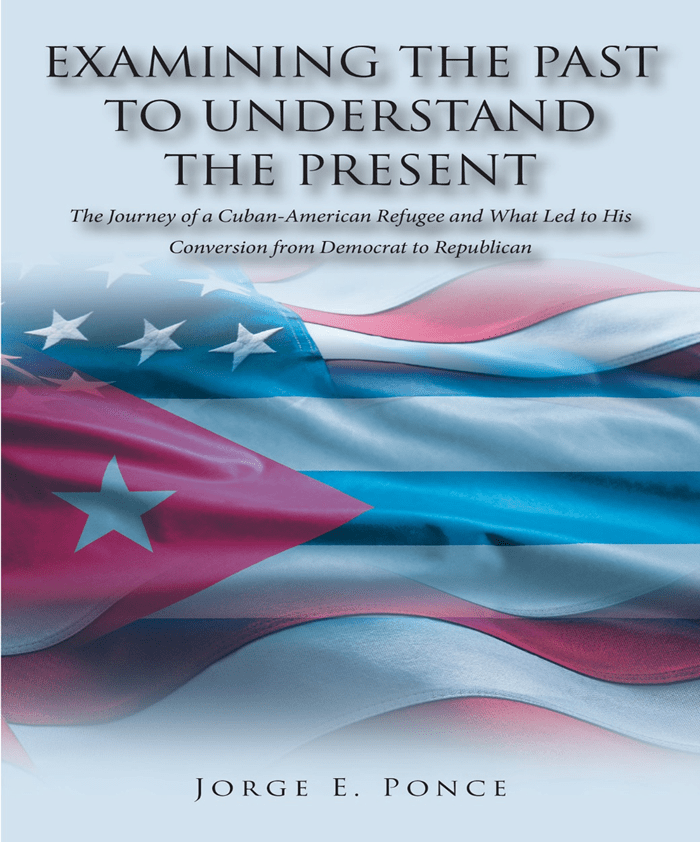
Author Jorge E. Ponce, a Cuban American who came to the United States with his family as political refugees via the Freedom Flights in 1966, has re-issued a new edition of his most recent book, “Examining the Past to Understand the Present: The Journey of a Cuban-American Refugee and What Led to His Conversion from Democrat to Republican”: a powerful memoir that follows the author through his immigration to America as a political refugee, and his eventual turn to the political right after years of disappointment from Democrats and witnessing the dangers of communism.

The new edition has additional articles and an updated/ expanded introduction.  The good news is that while this edition has more material, it also has a cheaper price tag.  More for less – an enviable combination for today’s consumers. 

Born in Havana, Cuba, Jorge grew up in Arlington, Virginia, and retired to the Sunshine State of Florida. He has used his pen prolifically to write his views about issues that needed to be aired so that others in the media and diverse communities got the other side of the story. The author’s letters to the editor have been published frequently in the Washington Post, the Washington Times, and the Tampa Bay Times. Ponce has worked for the Federal Government for his entire professional career and has received multiple awards for his civil rights work. Now that he’s enjoying his retirement, he considers himself lucky to be able to write about topics that move his soul.

“This book will be helpful to those who have made the decision to leave their homeland,” writes Jorge. “It will not be an easy transition at first. The younger you are when you become an immigrant or a refugee, the better you will be able to adapt to a different culture and language. But you must embrace a frame of mind that you are in a new country to assimilate into its culture; not to change it.  Achieving the American Dream proved that the journey was well worth it!

Jorge continues, “This book will also be helpful to politicians who wonder how to get and keep a big chunk of the Hispanic vote on their side, as well as those who wonder how they lost it. It will be an eye-opener to those who can’t figure out why it’s so difficult to get Cuban Americans to vote for Democrats. Past experience living an arduous life under a Communist regime leaves indelible scars about the Left that can never be erased.” More importantly, you’ll be able to assess this political transformation from the mouth of a Hispanic — not from someone who claims to know the Hispanic culture. The latter makes a big difference to establish authenticity.

Jorge’s book brings the challenges, disappointments, and victories that destiny threw in his path to the forefront, revealing all the events that shaped him and his views on the nation’s political climate. Thought-provoking and deeply personal, Jorge provides answers to the ultimate questions of why the recent exodus of Hispanics to the Republican Party has taken place and the urgent need to keep this group in their tent to win future elections.

Parts 1-4 narrate Jorge’s life story in Cuba BC (Before Castro), Cuba AC (After Castro), United States, and his retirement in Florida.  After learning Ponce’s life history in the previous parts, Part 5 has sixty-seven articles on a myriad of subjects that have moved Jorge’s soul deeply ranging from politics, philosophy, religion, civil rights, Hispanics, and Cuban Americans. It is in Part 5 that Jorge discusses the reasons that led him to his conservative switch.  

Readers who wish to experience this enlightening work can purchase this book on the Amazon.com portal in multiple editions: hardback, paperback, and Kindle here.

CELEBRATE! CELEBRATE! DANCE TO THE MUSIC! / by Jorge E. Ponce

April 17th. What major events happened on this day?

1790: Founding Father Benjamin Franklin died. 1961: A CIA-sponsored paramilitary group of Cuban exiles land in the Bay of Pigs. 1964: The Ford Mustang is introduced to the North American market.

MY NATALITY DAY!

Anyone born in April has the Diamond birthstone. Diamond comes from the Greek word “adamas,” which means “invincible” or “unbreakable.”

As a son of the Aries horoscope sign, I’m energetic, independent, loyal, impulsive with a strong belief in carpe diem or seizing the moment, don’t follow the herd but do my own research, fully aware that while you can always earn more money, you can never get back more time.

I put more emphasis on living the “now” – as “someday” is not a day in the calendar.

I often ask myself what would the world look like without Aries people, and my answer is very depressing — “a total eclipse of the planet.” (LOL).

Among the Aries luminaries are Willy Chirino of “Nuestro Dia Ya Viene Llegando” fame, Leonardo da Vinci, Thomas Jefferson, Toshiro Mifune, Aretha Franklin, and Sandra Day O’Connor.

As a reminder of my Ponce surname with the 16th century Spanish explorer Juan Ponce de Leon, I claim that my youthful look has something to do with the secret of the “fountain of youth” – which is currently located in St. Augustine, Florida. But when I visited it, it looked like a pond with dirty water with no magical attributes.

Subsequently, I found solace in the following quote from wise “Italian” Sophia Loren: “There is a fountain of youth: it is your mind, your talents, the creativity you bring to your life and the lives of people you love. When you learn to tap this source, you will truly have defeated age.” Amen to this!

I learned during my fall season that life is no longer about “chasing things” but about “choosing better.” Although during my earlier seasons, I was quite careful and picky about the things that I chased.

I’ve been getting my hands on all the vitamin supplements that I could find and exercising regularly after reading the wonderful prediction by American computer scientist, author, inventor, and futurist Ray Kurzweil. He claims that humans will have the option to choose immortality by the year 2030! I have five years to consider whether I want to take advantage of this option or not. LOL!

Had Ray Kurzweil lived during the time that Egyptian pharaohs reigned, imagine how much money and stress he would have save them after convincing them of the futility of building the Giza pyramids as a repository of all the things that they would need to make a smooth transition to the afterlife. Think of how lucky we are!

To find out about Kurzwell’s prediction, click on Reaching Immortality

I want to thank in advance all those friends and acquaintances who offer me their best wishes on this day.

Cheers and Pa’lante (Forward)!!!
Photo taken in May 2023 in Lake Como, Italy.

REAL MEN.  REAL FRIENDS / by Jorge E. Ponce

I’ve wondered lately what it takes to have “real” friends where I live.  Real ones are the ones who know you deeply and care about your wellbeing – not the ones who greet you with “how you’re doing without listening to your responses” or those who act like weathermen.

When I go to Miami, I get a chance to socialize with my sister’s Cuban American friends.  I did not know these people when I was growing up.  I met them just a couple of years ago.  And yet, I feel a camaraderie with them that speaks of authenticity. 

Could “real” friends be limited to a subset of people who share your nationality? In my case, those who are Cuban Americans? Or is the net cast much wider to include people of all nationalities, races, religion, and political affiliations who share common personality traits and values?

Jeffrey Marx addressed this question in his outstanding book “Season of Life” as he describes the exploits of former NFL football star for the Baltimore Colts and volunteer coach for the Gilman High School football team – Joe Ehrmann.  

After reading this book, I now expand my answer to this question based on my own life trajectory.

Joe attributes many of society’s problems to the misguided perception of what “real” boys, teenagers, and men are like.  Since Marx’s book was published in 2004, there have been a lot of societal changes.  With women joining the labor force in greater numbers and many receiving college degrees, the issues that Marx and Joe addressed now apply to women as well. 

Author and coach opine that the inability of males to find “real” friends has its origins in society’s paradigm of always been in a marathon.  If your aim is to win a race, singing Kumbaya with others is not in your arsenal.  Getting first prize becomes the ultimate goal!

Coach Joe said that the race starts in elementary school when our athletic skills are first tested, followed by our romantic quests in high school, and ending with wallet considerations as adults. 

Boys in elementary school who excel in sports are treated like royalty for their masculinity.  They can do no wrong, as everyone protects their backs.  Those lacking in athletic prowess are relegated to lesser humans – even if they are straight A’s students. 

Upon reaching puberty and getting their hormones activated during the high school years, teenagers who score the prettiest and sexiest girls get to wear the new crowns.  With inflated egos, teenage boys don’t care much about getting to know the girls whom they hang out with.  They think it’s a privilege that they grant these girls to go out with them.  This mindset turns the boys’ brains into dominating/power wielding machines.  

Finally, these men join the labor force.  Success is measured by job titles, cars, designer clothes, bank accounts, neighborhoods lived, and lived-in houses. 

When I was part of the federal workforce and took part in after-hour social events, the first rule of protocol when meeting someone new was to exchange business cards.  The job title printed on the business card determined most of the times how long the new acquaintance spent talking with you.  It was not unusual to have a follow-up question regarding what your salary was.  The answer to this question sealed the deal for the impromptu exchange.  If your salary was lower than the questioner, you would get a mere 2-minute conversation about insignificant matters.  If both shared the same salary, the conversation was extended to 5 minutes that might include political issues that impacted the bureaucracy.  But, if you had a higher salary, you were rewarded with a 30-minute conversation only if you were willing to discuss your game plan that led to your current salary and share high rollers who might be help them reach your same salary level or exceed it.  There is nothing wrong with the questions raised in the last sentence, if they were not limited to them.  But they were the majority of times. Curiosity about your hobbies, your family, or your happiness were not important.

With the above personality traits, there is no way that you could make “real” friends.  Others don’t get to see the real you.  They are only exposed to your façade, your mask.  This prevents others from opening to you – as they recognize that your priorities are totally misguided.  In other words, they might think: “why waste our time with such a narcissist?” They see you as someone who is me-oriented with no room for others’ feelings.  And this explains why at the end of their journey, the pets become their only friends.  Animals react well to command-and-control orders. Not to imply there is anything wrong with having pets, only that you need to expand your circle of friends.

So, what’s the secret to procuring “real” friends?

This concept is not limited to one’s nationality.  It has everything to do with people who know what really counts in life!

For one, men have to be willing to show their emotions.  When a situation moves you to tear up, do so.  When someone needs a helping hand, give it.  When a fatherless person seeks fatherly advice, offer it.  When going out of your way to fight for freedom, fight for it. 

It can’t always be about you.  It helps to get “real” friends to your orbit when they see that you fight for a cause that is bigger than yourself.  For example, regardless of my political orientation at any particular time in my life, I’ve always done my grain of sand to write letters to the editor to expose the oppression of the Cuban people by a communist dictatorship that has been in place for sixty-six years.  This oppression of Cubans has been the best kept secret for Americans who rely solely on the fake-news media outlets.

I don’t know any of these Cubans, but I fight for them because I believe that every individual is entitled to live a life that guarantees life, liberty, private property, and the pursuit of happiness. If they were to speak out against Cuban government officials, they would get unjust and long jail sentences.  I speak out for the voiceless from the land of freedom!

My Miami friends have become “real” friends because we are bonded by the fact that we faced political persecution when we lived in communist Cuba.  Our parents lost all their material possessions so that we could live in freedom.  My friends know that material things can be acquired and lost in a matter of seconds.  What counts for them is to know you for who you really are – your victories, your failures, your values, how you treat others who are less fortunate, what you do to make a better world for all.  They are not concerned with competing with you or outdoing your achievements.  They celebrate you for being their friends and for sharing the true, authentic You with them!

Ancient Greek Philosopher Aristotle recognized that “man is by nature a social animal.” But to live a rewarding and meaningful life, man needs the company of “real” friends. 

JUDGING THE MEANING OF LIFE / by Jorge E. Ponce

A recent event in my family made me ponder on what makes a virtuous life.  How the people who knew you will remember you after you are gone?  Reading Richard E. Simmons III’s book “The True Measure of a Man” provided some insightful ideas.

I came up with three attributes that will make someone into a virtuous person and be well- though-out by others.

The first attribute is to have a good “character.” The best way to summarize what this entails is the ability to do the right thing based on sound logic.  This comprises decisions that are made on moral grounds – as well as those made on sound judgment, like those on how to deal with teenage sons and daughters or which are the factors to keep in mind when considering career choices or career changes. 

The second attribute deals with making decisions that are based on “wisdom” or sound logic. In other words, seeing things and situations as they really are rather than as they appear to be.  Wisdom is measured not on the quantity of knowledge that we have accrued but rather on the quality of what we have garnered.

The third attribute is to have compassion and to have quality relationships.  It comprises the ability to love and be loved by others.  Some people make the mistake of leading their lives based on comparing and competing with friends and coworkers.  Doing the latter leads to lives of isolation where, at the end of the day, the only friends they have are their pets.  Real friends are those that you feel comfortable tearing down your defense mechanisms and exposing your fears, failures, disappointments, and views on controversial/political subjects without being concerned with their rejection of you. 

As we consider our legacy that we leave behind, Stephen Covey in his book “The Seven Habits of Highly Effective People” suggests what it would be like if we attended our own funeral.

“As you take a seat and wait for the services to begin, you look at the program in your hand.  There are to be four speakers.  The first is from your family, immediate and also extended – children, brothers, sisters, nephews, nieces, aunts, uncles, cousins, and grandparents who have come from all over the country to attend.  The second speaker is one of your friends, someone who can give a sense of what you were as a person.  The third speaker is from your work or profession.  And the fourth is from your church or some community organization where you’ve been involved in service.

Now think deeply.  What would you like each of these speakers to say about you and your life? What kind of husband, wife, father or mother would you like their words to reflect? What kind of son or daughter or cousin? What kind of friend? What kind of working associate?

What character would you like them to have seen in you? What contributions, what achievements would you want them to remember? Look carefully at the people around you.  What difference would you lie to have made in their lives?”

The late American auto executive Lee Iacocca said “Here I am in the twilight years of my life, still wondering what it is all about … I can tell you this, fame and fortune are for the birds.”  Living a virtuous life has to do more with the difference that we made in the lives of others.

Examining The Past To Understand The Present / Jorge E. Ponce

Some friends have expressed disillusionment at the disrespect that the United States has received lately from dictators, terrorist groups, free-speech detractors, and theocratic mullahs.  Most attribute this malaise to the weak foreign policies of former President Joe Biden. 

Other friends are outraged at the Biden’s economy where most Americans could hardly make ends meet because of inflation.  Despite all the feel-good, make-belief propaganda disseminated by Biden’s acolytes, Americans confronted reality when they went to pump gas for their cars, when they bought groceries at the supermarket, when they went out for lunch or dinner at a restaurant that had reasonable prices for their menu entrees in the past, when they purchased airfares for a needed vacation, when they went out to buy or lease a car, when they wanted to buy a house and the interest rates for a mortgage approached 8% – basically, when they bought any services that were affordable when President Trump occupied the Oval Office and which have started to improve under his second term.

Hispanics are the latest group to say that they’ve had enough with the failed policies of Democrats.  But this presents an “inconvenient truth” to the liberal cabal.  To discredit this switchover, they have called conservative Cuban-Americans all kinds of pejoratives – Batista sympathizers, inveterate hardliners, cavemen, reactionaries, Miami Mafia, and unauthentic Hispanics.  I’ve addressed the truth about Cuban-Americans by writing an article in my book.

Moreover, Hispanics realize instantly when politicians are only interested in their vote and not on their issues of concern.  When First Lady Jill Biden gave a speech in San Antonio, Texas and tried to ingratiate herself with Hispanic voters, she called them “breakfast tacos.” When Biden addressed a gathering of the Congressional Hispanic Caucus during the 2023 Hispanic Heritage Month, he mistook it for the Congressional Black Caucus. And some in the Democrat cabal have done the unthinkable when it comes to the Spanish language – they want to make it gender-neutral by using the term “LatinX.” Democrats ignore the basic fact that Latinos and Latinas will vote for politicians who have their backs.

It is smart when politicians learn directly from Hispanics what motivates them to vote and who resonates with their aspirations and values.  Hispanics do not react well when non-Hispanic politicians attempt to speak for them. 

Many Americans are ready to hang up their hats and say that the era of reaching the American Dream and attaining life, liberty, and the pursuit of happiness is over. I ask them a simple question: what have you done lately to restore freedom and democracy to the country that we all love?!!! Let the road to recovery begin with you!

It is precisely when answering my own question that I tell others what I have done lately for my country. I spent a year writing the book – and editing it with my wife’s help – “Examining the Past to Understand the Present – The Journey of a Cuba-American Refugee and What Led to His Conversion from Democrat to Republican.”

The book will be helpful to those “legal” immigrants and political refugees who have made the decision to leave their homeland. I narrate my life story in Cuba and the United States in parts 1-4 of my book.

Although the book has over sixty of my articles on many subjects ranging from politics, philosophy, civil rights, religion, Hispanics, and Cuban-Americans in part 5 of my book, I do dwell on my transformation from a Democrat to a Republican and what led up to it. I tell past friends who got annoyed with my conversion that life is a journey that cause us to learn new things, and that changes how we view the world.

But the challenge that I’ve faced is to market the book in conservative and Hispanic networks.  The conservative ones have ignored my interview requests because I’m not a public figure like the ones who publish books regularly on the Fox News network.  The Hispanic ones don’t want to hear from me because they think that my book message is antithetical to their leftist ideology. 

Make a difference.  Buy my book.  Write a review. Help out a conservative who contributed his grain of sand to “Make America Great Again!”