WHY IS COMMUNISM POPULAR IN THE U.S. IN 2026? / by Jorge E. Ponce

I’m amazed that with so much documented history on the failures of every communist regime in history, there is an upsurge in sympathy in some sectors in the United States for socialism and communism. 

And make no mistake about it.  Socialism, Democratic Socialism, and Communism are all part of the same leftist propaganda to obfuscate the uninformed.  There is absolutely nothing “democratic” about socialism or communism.  If you don’t believe me, look at the official name of Communist North Korea – “Democratic” People’s Republic of North Korea.  I don’t think many people think Kim Jong Un cares much about democracy or his people.

The communist virus is being spread in our U.S. cities, in our elementary schools, in our high schools, in our colleges, in our universities, in city halls, and in the U.S. Congress.  And Americans who love our Judeo-Christian traditions, our freedoms, and our democracy cannot sit still.

Just focusing our attention at the 20th century, over 100 million killings have been attributed to communist dictators like Stalin, Mao, Pol Pot, and Fidel Castro.  Peaceful protesters lack the most fundamental protections in these rogue countries.  They either get long jail sentence, sent to labor camps, or suffer the ultimate punishment of death. 

But I ask myself, hasn’t Americans supporting these regimes learned of their crimes and failures in history books, schools and universities, and media outlets?

One of the answers to this question is that the rarest thing for most Americans nowadays is to read a book.  Even with the availability of audio books, most claim that they lead such busy lives that reading a book is a luxury that they don’t have.  They let others do the thinking for them. And, they forget the wisdom that an educated citizenship is necessary for the survival of freedom. 

In schools and universities, there are too many teachers and university professors who simply don’t hold any allegiance to the foundational documents of our Nation.  In fact, many hold views that are the antithesis of our Judeo-Christian values and propose the overthrow of our system of governance.  If the perpetuation of our culture lies with the younger generation’s buy-in, this challenge must be addressed immediately.  One of the best solutions is to give parents the option to send their children to charter schools that have America-First curriculums.

With the scarcity of well-read Americans, media outlets fill in the gaps.  But with most TV networks and newspapers having a left-wing bias and with soundbites lasting no longer than 1 minute, listeners and readers get their minds filled with anti-American ideologies.  And by doing so, they become the useful sheep who will purchase the rope to hang themselves. 

When you ask many of these useful idiots why they hate President Trump, they respond with illogical answers like they don’t like any kings.  But if we are to examine what U.S. presidents have behaved like kings, we have to look no further than at Joe Biden who selected his successor without consulting the wishes of the voters.  This is what kings and queens do when dealing with succession to the throne – only members of the Royal Family belong to this club.

After I – with my family – immigrated to the United States many years ago, I made it my business to tell as many Americans as I could about the hardships that I had endured in Communist Cuba.  But I realized quickly that they did not take me seriously.  For this, I do not blame them for my physical appearance then left a lot to be desired.  I was undernourished, not very muscular, and my dress attire was not very fashionable.  I can see that many must have thought that I looked like a geek.

All of this changed after I gained better English fluency, became more athletic by joining the rowing team, and dressed more fashionable.  My letters to the editor started getting published in the Washington Post and the Washington Times.  I was more outspoken in high school and college about my dire experiences with Cuban communism and communism in general. 

Nevertheless, a turning point was reached with the Vietnam War and Watergate.  With a very unpopular war and a failed presidency, many Americans felt betrayed by their government and Chief Executive.  The Viet Congs, Fidel Castro, and Che Guevara gained popularity with this crowd.  Yankee imperialists – not the baseball team – became the enemy.  When many of these Americans joined the labor force, they gravitated to professorships at our colleges and universities where they could mold the minds of students into faithful followers of Marx and Hegel.

When Cuban Americans warned Venezuelans that their country could fall into the orbit of communism in the late 1990’s, they laughed and said that Venezuela was not like Cuba.  And Hugo Chavez and Maduro turned Venezuela into a failed communist state.  And after this happened, many Venezuelans were no longer laughing, but it was too late.  Many voted with their feet by immigrating to the United States. 

With so many Cuban Americans and Venezuelan Americans warning Americans about the communist infiltration in their country, are they listening now? The majority of Cuban Americans and Venezuelan Americans do not have the geeky appearance that I had when I came from Cuba.  They are highly successful businessmen/women and politicians who love America, the American Dream, and capitalism. 

The answer is that many Americans think that what happened in Cuba and Venezuela can never take place in the United States.  But they don’t have to look to the Caribbean, Central and South American to get an answer.  All they need to do is to look at the rapid deterioration of fiscal responsibility and law and order in U.S. cities like Chicago, New York City, and Seattle run by leftist mayors. 

And there is no question that the United States has made plenty of errors in the past.  Considering that humans are not infallible, this is to be expected.  In the early years of our republic, only white males who were property owners could vote in elections.  Slavery was sanctioned even though it was counter to the ideals of the Declaration of Independence.  But the country corrected its past mistakes by freeing the slaves, making them U.S. citizens, and giving them the right to vote.  It later gave women and Native Americans the right to vote.  Many more errors were eliminated to make our Land the most prosperous civilization that humans have ever experienced.

Why is socialism/communism so popular with these gullible people?

You must understand that the only thing that communist dictators care about is power and how to keep it.  The first thing that they go after is religion – Marx called it the opium of societies.  There can only be one god to this cabal, and it’s the Communist Party.  Citizens’ well-being and lives are secondary agenda items.  But considering that so American values are derived from the Bible, communist agitators copy many of the Christian principles to sell their ideology.  You hear them saying that communism cares about open-borders, looking out after the poor, providing equal wages for employees, lowering prices at supermarkets and bus transportation, and eliminating the very rich.  In other words, a communist country is the utopia that many dreamed of.  Who can object to these generous options?!!!

But those who get their information from leftist fake-news outlets and publications fail to do their own research – to their detriment.  These are the people that you see yelling anti-American rhetoric at No-Kings rallies and May-Day protests.  None have stopped to think that there has not been one communist country in the history of the world that has improved the lot of its citizens. None have stopped to read about the high-crime and fraud rates in U.S. cities run by leftist mayors. 

And yet, these leftist fools want to negate the vote of 77 million Americans who elected President Trump to a second term.  Logic is foreign to them.  Following is how they think. America and capitalism are the devils that need to be abolished.  President Trump must be impeached and put to prison.  The Bill of Rights and the U.S. Constitution are foundational documents that need to be discarded for having been drafted by white-racist oligarchs.  President Trump is a Nazi but many support the candidacy for the U.S. Senate from Maine of Graham Platner who does have a Nazi tattoo.  Logic is not their forte!

MAGA Americans will never let this happen.  But they cannot get complacent.  They must fight back in every venue, in every media platform, in every election, in every gathering.  Every time in the past that our well-being has been endangered, Americans have risen to the challenge. 

This is one of those moments when we have to deliver and safeguard an America enshrined in the Judeo-Christian values that are found in the Declaration of Independence, the U.S. Constitution, and the Bill of Rights.

PATRIA Y VIDA / by Jorge E. Ponce

“Patria y Vida” or “Homeland and Life” – a protest song that became the anthem of the largest protest demonstrations in Cuba in 2021. 

Written by Yotuel Romero, the group Gente de Zona, Descemer Bueno, Maykel Osorbo, Eliecer “el Funky“ Marquez Duany,  and Beatriz Luengo (Yotuel’s wife), it won song of the year and best urban song at the 2021 Latin Grammy awards.  

“Patria y Vida” is an inversion of the Communist Cuban slogan of “Patria o Muerte” — “Homeland or Death.”

There is a world of difference between the conjunctions “and” and “or” – between “y” and “o.” The latter symbolizes a my-way-or-the-highway mindset.  Completely totalitarian.  It leaves no room for individual thinking – typical of the communist ideology where the Communist Party is supreme.  It is also delusional to think that Cubans would be willing to die for a homeland ruled for sixty-six years by a totalitarian regime that has denied them the most basic human rights. 

On the other hand, “patria y vida” offers the option to aspire to a homeland where the dignity and prosperity of all citizens would be implemented – a homeland of, by, and all Cubans.  A homeland where no one would be left behind.  

Despite the bogus claim by Cuban authorities, racism is still prevalent in Cuban society.  Yotuel recounts the following incident in Cuba: “Once I was walking down the street with Bea (Beatriz Luengo, who is white and a Spaniard) and they told her: Wow, you’ve set the race back.”  

With the exception of Beatriz, the other composers of this song are all Afro-Cubans.  But this did not stop the official website CubaDebate to label Yotuel a “jinetero” (“prostitute) for marrying Beatriz.  Cuban Government sympathizers forget the basic fact that love has no racial barriers.  Love is an emotion that triggers an unstoppable chemical reaction in the heart.

But this was not all.  Back in 2020, an agent of the Castro regime wrote on social networks the following: “He [Yotuel] has reached where he has arrived thanks to Fidel and the Revolution without whom he would only have been a black shoeshine boy.”

Yotuel does not live in Cuba anymore for political reasons and dreams of returning only to a Cuba Libre.  If the Cuban Revolution had taken Yotuel under its wings, there would have been no need for him to emigrate.  Indeed, outside the Cuban Revolution, Yotuel is now a very successful musician with multiple awards under his belt.  It is not inconceivable that if he had stayed in Communist Cuba, his destiny would have been nothing more than that of a “black shoeshine boy.” He found fame, a loving wife, and a society that rewarded talent and not race outside of Cuba.

The massive demonstrations on July 11, 2021, had its genesis in Decree 349 – a Cuban law enacted in 2018 that obligated artists to get advance permission for public and private exhibitions and performances.  Government inspectors were authorized to confiscate the artwork of those breaking this law.  In September 2018, a group of artists who went by the name of “San Isidro Movement” launched a protest against Decree 349.  In February 2021, the song “Patria y Vida” was released.  In April 2021, residents of the San Isidro neighborhood impeded the arrest of rapper Maykel Osorbo and chanted the song “Patria y Vida” and other anti-government slogans. 

It was only a matter of time before things took a turn for the worst.  July 11, 2021 saw the largest anti-government protests since 1994.  Cubans denounced cultural censorship, food and medicine shortages (especially during the COVID pandemic), lack of basic human rights, the government’s hypocrisy regarding racial and socioeconomic equality, and the unfulfilled promises to bring about economic and political reforms.  Cubans got tired of the communist charade and demanded a change.  They dreamed of a country where they could prosper, grow, live, and vote in free elections for political candidates of their choice. 

Rather than meeting with the leaders of the demonstrations, the Cuban government made hundred of arrests and charged many with crimes that included sedition.  Maykel Osorbo was arrested in May 2021 and is currently serving a nine-year prison sentence.   

The fact that one of the composers of this song, Maykel Osorbo, is serving a jail sentence because the Cuban authorities feared the emotions that it engendered demonstrates vividly the weakness of the Cuban Communist regime.  Its sustainability is only possible by repression.  A song being an existential threat to the Cuban authorities?!!! Laughable!

I am not a fan of rap, hip-hop, reggaeton, and cubaton music. To me, music entails harmony, and the latter genre lack it.  Nevertheless, I do like the message that this song brings to the table.  As a social protest to the dire conditions that Cubans have endured for over sixty years, where the average salary of a Cuban worker in 2025 is a meager $17, where there has been a 24% decline in the Cuban population during the last four years since 2024 due to massive mass migration (which puts the Cuban population at 8M), I stand firmly in solidarity with “Patria y Vida.”  

The recent Cuban migration could be designated as a “reverse Pedro Pan Program.”  The original “Pedro Pan Operation” was a clandestine exodus of over 14,000 unaccompanied Cuban minors ages 6 to 18 to the United States over a two-year span from 1960 to 1962 to save them from communist indoctrination.  The current program differs from the original because it entails parents leaving their children with their parents or close relatives in Cuba because of the risks associated with sea and land crossings. The original program took children out of Cuba while the current one kept children in a communist country. 

It easier for some people to capture the essence of a message or a story by reading a book.  Others favor instant gratification and prefer getting information through a song.  Others gravitate towards the visual arts to get informed. 

It is because of the latter group that Beatriz Luengo memorialized the impact that her husband’s song had worldwide by producing a documentary.  “Patria y Vida: The Power of Music” debuted in most AMC theaters in Florida on July 11, 2025. It is expected to be released in other areas of the U.S. shortly. The documentary lasts ninety minutes to symbolize the ninety miles that separate Key West from Havana.   

The song and the documentary have united Cubans living in Cuba, Cuban-Americans, and Cubans throughout the world into one family wanting a change in their homeland for democracy and a free-market economy where everyone can move up the social scale based on his/her talents. 

Patria y Vida, Venceremos! With the “Homeland and Vida” chant, we will attain Victory!

SIGNIFICANCE OF MAY 20, 1902 TO CUBA / by Jorge E. Ponce

May 20, 1902? What’s commemorated on this date? Is it Cuban Independence from Spain? Should only Cubans be concerned about this date?

To determine the answer to this question, one must delve into the history of Cuba.  But this becomes a difficult task for most Cuban-Americans who emigrated at an early age to the United States since 1959. 

Take, for example, someone like me.  The Cuban Communist Government forced parents to enroll their children in government-run schools to instill in them Marxist propaganda.  Private and religious schools were closed permanently, and the teaching staff was either laid off or forced to emigrate mostly to Spain.  This created a shortage of teachers with credentialed backgrounds – which undermined the teaching of basic subjects.  Therefore, my three years spent in these schools centered on learning about the Cuban, Bolshevik, and Mao revolutions.  History about Cuba BC (Before Castro) was banned for being bourgeois and unimportant. 

After coming to Arlington, Virginia, my focus was on learning the history of the United States.  As time went by, English became my primary language.  Although I was fortunate to attend lectures on Cuban history in Spanish by distinguished Professor Herminio Portell Vila and his assistant Ms. Isabel Pruna, my language proficiency and retention-ability became less and less.  To make matters worse, there were not many books in English pertaining to the history of Cuba BC.  This is why I have praised Cuban-American Professor Alfred J Lopez for penning recently the first book in English about Cuban National Hero Jose Marti.  

So, let’s delve back into the real significance of May 20th for Cubans – but before doing so, let’s review some background events in Cuban history.

Multiple U.S. President had wanted to annex Cuba as a U.S. state.  Thomas Jefferson, the third President of the United States, wrote to James Madison in 1809 about the fact that Cuba was only ninety miles from Key West, Florida and located at the mouth of the Gulf of America.  Democrat Presidents James Polk in 1848 and Frankling Pierce in 1854 offered to buy Cuba from Spain to add the Caribbean Island to the Southern slave-owning states.  Slavery was abolished in the United States by the 13th Amendment in 1865, and in Cuba in 1886.  Democrat President James Buchanan also favored buying Cuba from Spain, but the Ostend Manifesto of 1854 allowing the U.S. to seize Cuba by force if Spain refused to sell it was voted down by the U.S. Congress.  After 1865, calls for Cuba annexation by U.S. congressmen decreased significantly.

It helps to get a feel for the mood of most Americans concerning the annexation of multiple Caribbean Islands during this time.  Republican President Ulysses S. Grant supported a treaty drafted in 1870 to annex the Dominican Republic as a way to reinforce the Monroe Doctrine and find a haven for African Americans fleeing persecution in the Reconstruction South. Abolitionist Frederick Douglass supported this annexation as a way to uplift the island from poverty.  But the U.S. Senate defeated this measure because many believed that non-white people in the Caribbean were unfit for American citizenship and feared that the United States would absorb “degenerate races.”

It was thanks to Cuban National Hero Jose Marti that the character of Cubans was safeguarded after he challenged in writing a defamatory column that was published in the Manufacturer of Philadelphia and reprinted in the New York Evening Post on March 25, 1889.  The column labeled Cubans as “destitute vagrants or immoral pigmies,” “petty talkers, incapable of action, hostile to hard work,” “an effeminate people,” “people of defective morals … unfitted by nature and experience to discharge the obligations of citizenship in a great and free country,” and “our lack of manly force and of self-respect is demonstrated by the supineness with which we have so long submitted to Spanish oppression, and even our attempts at rebellion have been so pitifully ineffective that they have risen little above the dignity of farce.”

Marti was prophetic in advocating against the annexation of Cuba — as it was unwise to do so with a country that thought so poorly of its patriots (men who had fought for so long a European country with no help from the civilized world). 

Cuban patriots fought three wars to gain their independence from Spain – the ten years’ war lasting from 1868 – 1878, the little war from 1879-1880, and the war of independence from 1895 – 1898.  During the 1895 war, the Cuban population was approximately 1.8 million. According to the Library of Congress Research Guide, 20% of the Cuban population perished during the wars – including combat death and the effects of Spanish General Weyler’s reconcentration policies. This amounts to 360,000 Cuban casualties!  I don’t think that anyone with an iota of intelligence and moral fortitude would label these patriots “effeminate people!”

After the sinking of the USS Navy Ship Maine in Havana Harbor in February 1898, which the jingoistic media outlets blamed Spain for it, Republican President William Mckinley received a Congressional joint resolution on April 20, 1898, to intervene militarily to secure Cuba’s independence.  U.S. troops landed at Guantanamo Bay on June 10th, and a cease-fire was reached on August 12, 1898 – followed by the end of the Spanish-American war by the signing of the Treaty of Paris on December 10, 1898. The treaty also ceded Guam and Puerto Rico to the United States — as well as Spain agreeing to sell the Philippines for $20 million.  Teddy Roosevelt and the Rough Riders gained fame and recognition for their participation in multiple battles — like the one in San Juan Hill.

Despite the fact that Cuban patriots had fought valiantly for fourteen years to gain their independence and that they had lost 20% of their population in these efforts, the United States delegates — whose military had participated in the Cuban wars for a mere two months – prevented Cuban representatives from participating in the signing of the Treaty of Paris.  Moreover, U.S. General William Shafter refused to allow Cuban General Calixto Garcia and his rebel forces to participate in the surrender ceremonies in Santiago de Cuba.

You may ask what prevented the United States from invoking the Monroe Doctrine and annexing Cuba prior to the U.S. declaration of war against Spain in 1898? Senator Henry Teller of Colorado succeeded in having his amendment passed by the U.S. Congress in 1898 that stipulated: “The United States hereby disclaims any disposition or intention to exercise sovereignty, jurisdiction, or control over said island except for the pacification thereof, and asserts its determination, when that is accomplished, to leave the government and control of the island to its people.” It turns out that the Senator’s motives were not necessarily altruistic but were triggered by his efforts to protect the beet industry from cheap Cuban cane sugar imports. In fact, Senator Teller went on to support the Platt Amendment.

So, we are ready now to answer the question about the significance of May 20, 1902.

If Spain ceded control of Cuba via the Treaty of Paris, what happened in Cuba between 1898 and 1902?

On January 1, 1899, the United States commenced the formal military occupation of Cuba – in strict violation of the Teller Amendment.  The majority of Cubans agreed with the warning of Jose Marti regarding his quote that “to change masters is not to be free.”

From 1898 to 1902, the United States controlled the government of Cuba. President Mckinley had always wanted to have strong control over Cuban affairs.  After his assassination in 1901, Vice President Theodore Roosevelt took over the presidency and continued Mckinley’s policies towards Cuba. 

With the signing by President McKinley of the Platt Amendment in 1901 – which President Franklin Delano Roosevelt abolished in 1934 — the United States abrogated Cuba’s right to make treaties with other nations and restricted Cuba’s ability to conduct foreign policy and commercial relations.  It allowed the United States to intervene militarily to theoretically preserve Cuban independence, although realistically it was to protect the U.S. investments on the Island. It also allowed the United States to lease the Guantanamo Naval Base.   

May 20th, 1902 was the date when the Cuban Republic was established and Tomas Estrada Palma became its first president.  While symbolically this date represents the end of the American military occupation, the U.S. military did intervene multiple times in Cuban affairs until the abrogation of the Amendment in 1934. 

Now that we’ve dealt deeply into Cuba BC’s history, it becomes obvious that the U.S. interventions in Cuba affairs from 1898 to 1934 did a lot of harm to the development of Cuba as a free and independent republic. 

Some say that the Cuban Republic lasted from 1902 to 1959 with the rise of the communist regime of Fidel Castro.  I and I’m sure others think that the Cuban Republic lasted only for 24 years – from the ending of the Platt Amendment in 1934 to 1959.  This is not enough time to reach maturity as a free country and differentiate between governments that uphold the inalienable rights of life, liberty, private property, and the pursuit of happiness from those that suppress these rights by making its citizens slaves of totalitarian ideologies.

Had I lived in Cuba BC as an adult, my political affiliation would have sided with the Cuban nationalistic aspirations.  A young republic deserved to have a “government of the people, by the people, and for the people” to quote President Lincoln’s famous quote – without any foreign interference.  Cuban politicians deserved an opportunity to make the right decisions and to learn from its own mistakes.  Denying Cubans this trial-and-error transition prevented the maturity it needed later to maintain its adherence to democratic policies and fend off their sequestration by totalitarian ideologies. 

The history pertaining to May 20, 1902, should not be limited to Cubans.  Peoples from all over the world will learn from it and ensure that it’s not repeated.  What happens to the least of all is important to all – as we are all part of the human history.

Presidential messages may muddle the significance of this date.  For example, the 2025 message states: “This Cuban Independence Day, we honor the courageous patriots who broke free from Spanish colonial rule …”

Does this history lesson mean that I am anti-American? Absolutely not. I am an American citizen and love this country.  But to quote the late Spanish philosopher George Santayana, “those who ignore history are doomed to repeat it.” The difference between the United States and communist countries is that the former has corrected its past mistakes while the latter holds on to them to keep themselves in power.

Now, you know the rest and the real story!

JORGE’S BOOK RE-ISSUED

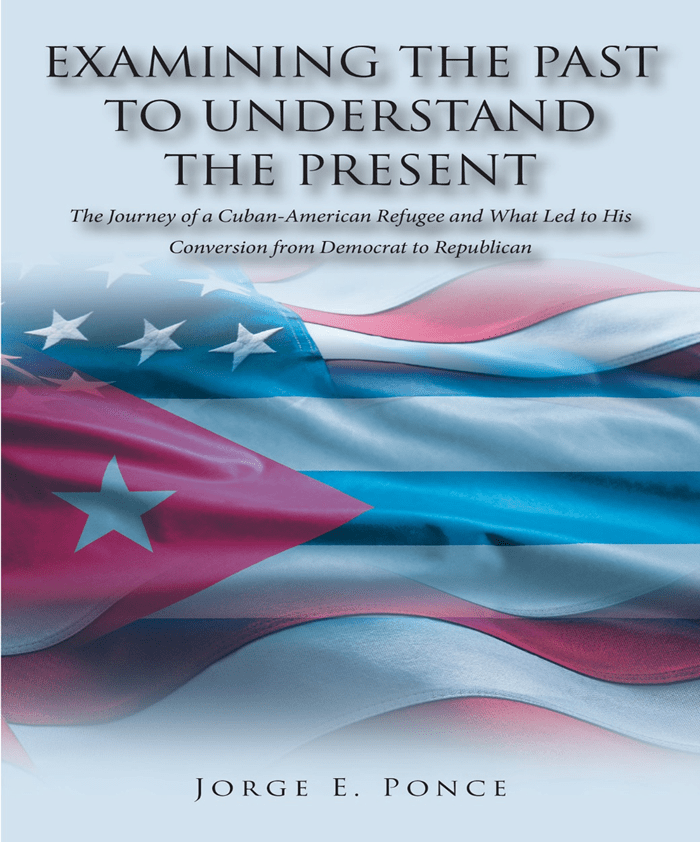
Author Jorge E. Ponce, a Cuban American who came to the United States with his family as political refugees via the Freedom Flights in 1966, has re-issued a new edition of his most recent book, “Examining the Past to Understand the Present: The Journey of a Cuban-American Refugee and What Led to His Conversion from Democrat to Republican”: a powerful memoir that follows the author through his immigration to America as a political refugee, and his eventual turn to the political right after years of disappointment from Democrats and witnessing the dangers of communism.

The new edition has additional articles and an updated/ expanded introduction.  The good news is that while this edition has more material, it also has a cheaper price tag.  More for less – an enviable combination for today’s consumers. 

Born in Havana, Cuba, Jorge grew up in Arlington, Virginia, and retired to the Sunshine State of Florida. He has used his pen prolifically to write his views about issues that needed to be aired so that others in the media and diverse communities got the other side of the story. The author’s letters to the editor have been published frequently in the Washington Post, the Washington Times, and the Tampa Bay Times. Ponce has worked for the Federal Government for his entire professional career and has received multiple awards for his civil rights work. Now that he’s enjoying his retirement, he considers himself lucky to be able to write about topics that move his soul.

“This book will be helpful to those who have made the decision to leave their homeland,” writes Jorge. “It will not be an easy transition at first. The younger you are when you become an immigrant or a refugee, the better you will be able to adapt to a different culture and language. But you must embrace a frame of mind that you are in a new country to assimilate into its culture; not to change it.  Achieving the American Dream proved that the journey was well worth it!

Jorge continues, “This book will also be helpful to politicians who wonder how to get and keep a big chunk of the Hispanic vote on their side, as well as those who wonder how they lost it. It will be an eye-opener to those who can’t figure out why it’s so difficult to get Cuban Americans to vote for Democrats. Past experience living an arduous life under a Communist regime leaves indelible scars about the Left that can never be erased.” More importantly, you’ll be able to assess this political transformation from the mouth of a Hispanic — not from someone who claims to know the Hispanic culture. The latter makes a big difference to establish authenticity.

Jorge’s book brings the challenges, disappointments, and victories that destiny threw in his path to the forefront, revealing all the events that shaped him and his views on the nation’s political climate. Thought-provoking and deeply personal, Jorge provides answers to the ultimate questions of why the recent exodus of Hispanics to the Republican Party has taken place and the urgent need to keep this group in their tent to win future elections.

Parts 1-4 narrate Jorge’s life story in Cuba BC (Before Castro), Cuba AC (After Castro), United States, and his retirement in Florida.  After learning Ponce’s life history in the previous parts, Part 5 has sixty-seven articles on a myriad of subjects that have moved Jorge’s soul deeply ranging from politics, philosophy, religion, civil rights, Hispanics, and Cuban Americans. It is in Part 5 that Jorge discusses the reasons that led him to his conservative switch.  

Readers who wish to experience this enlightening work can purchase this book on the Amazon.com portal in multiple editions: hardback, paperback, and Kindle here.

Meet Jorge and Siomara Ponce

Jorge and Siomara Ponce live in The Champions’ Club in Trinity and are both Cuban-Americans.  After living most of their lives in Northern Virginia, they moved to Florida in the spring of 2014 after growing tired of their long work commutes to Washington DC from their suburban home and the cold weather, especially shoveling snow and raking leaves. 

Jorge worked for the Federal Government his entire professional career.  While a bureaucrat, he did not live his life as one.  He considers himself a fiscal conservative with a social conscience.  He has received multiple awards for his civil rights work in the past.  Now that he has retired, he keeps himself busy by writing articles with no filters on important issues. Siomara, on the other hand, worked in the corporate private sector in the area of human resources — for an international management consulting firm and an emerging markets private equity firm.

Although most people question why they would not prefer living in Miami in their retirement – as it is considered the Cuban Mecca in the U.S. – it was never an option for them as Miami is too congested and hectic.  They were seeking a laid-back community where peace was prevalent and yet someplace close enough to drive to Miami to visit family and enjoy their favorite Cuban food and music whenever they wanted.

In addition to these visits to Miami and to the Washington, DC Metropolitan Area to spend time with their son, daughter-in-law, two granddaughters, and lifelong friends, they take at least two extended trips annually.  They’ve traveled to Mexico, Panama, Germany, Ireland, France, Italy, Greece, the Greek Islands, Turkey, and Spain.  They love all the places that they’ve visited, but Italy remains the one country that speaks to their souls.  It has everything they enjoy the most — beautiful music, history, civilization, scenery, delicious food, and, most importantly, wonderful people who love to live life to the fullest and enjoy sharing their zest for living with others. The feeling is certainly contagious!!

Most recently they traveled to Spain on a 17-day vacation — although Jorge admits he did not necessarily want to go.  He only agreed after Siomara said she was going, “with or without him.” From a historical perspective, and as a Cuban-American who is very nationalistic, he always resented the killing of Cuban patriots like Martí, Maceo, Céspedes, and Agramonte when Cuba fought its War of Independence against Spain in the 19th century.   This goes back in history, he acknowledges that.  But in the 20th and 21st centuries, Spain has been one of the European countries that has invested heavily in Communist Cuba – business ventures that help prolong the suffering of Cubans and which are accessible only to those with foreign currencies. Considering his position and life experiences regarding Cuba, he had difficulties with the idea. It didn’t take him much time to acknowledge what a fabulous time they were having and to have followed Siomara’s “not so subtle encouragement.”

Jorge is passionate about writing and reading — and these passions led him to complete his book, “Examining the Past to Understand the Present: The Journey of a Cuban-American Refugee and What Led to His Conversion from Democrat to Republican.” This is a powerful memoir that follows the author through his immigration to America as a political refugee and his eventual turn to the political right after years of witnessing the embrace of many socialist policies by Democrats. Jorge’s book is available in hardcopy, paperback, and Kindle editions on multiple online portals like Amazon. Siomara played a pivotal role in editing Jorge’s book – as attention to detail is one of her strengths.

Jorge had multiple influences that led him to write the book.  He is a great admirer of the late political commentator Charles Krauthammer and loved one of his books (“Things That Matter”).  He was also mindful of Cuban National Hero José Martí’s quote: “there are three things that every man should do in his life: plant a tree, have a son, and write a book.” While Martí said these words in the 19th century, Jorge would update the quote to highlight the importance of being a parent to either a son or a daughter.  Having said this, the only thing that remained to emulate Martí’s message was to write a book.  Now, he’s in full compliance.

Jorge realizes how important Hispanics have become in the political circles in the United States.  He also recognizes the wisdom of past civil rights champions like Dr. Martin Luther King, Jr., in fighting discrimination by advocating the judging of all Americans by the “content of their character and not by the color of their skin.”  He firmly believes how important it is to reach a colorblind society to treat every American – without leaving anyone out – with the dignity and respect that every human being deserves. 

Jorge’s book also offers a shining light to legal immigrants who are navigating a new life in a new country with a different culture and language.  While there are many challenges to be faced, America is the best country in the world to bring prosperity to those who work hard and pull themselves up by their bootstraps.  This is Jorge’s story.  This is the story that he narrates in his book.

Jorge’s hobbies include good music (excluding reggaeton and rap), reading, travel, wine tastings, and enjoying the simple pleasures of life – a necessary thing to keep your sanity in a metropolitan area like the one in Washington, DC that desires to measure everything. He says that so many never learn that the things that really count are not countable!

Upon retiring, he found peace in himself when he accepted the fact that what really mattered at work was the difference that he had made in the lives of others.  He also gives thanks to his God for walking out unharmed through the many land mines that he was exposed to through the years. Many of his colleagues were not so lucky. He stated that upon his retirement, he walked out the door with his credibility intact, with his head held high, with the ability to look everyone straight in the eyes and enter through the front door. He left the workforce full of hope for each tomorrow.

Most importantly, Jorge embraced the urgency of enjoying those precious “momentos” with his immediate family and close friends—to show them by his deeds that they were the reason for attaining fulfillment in the autumn of his days, and to tell them that he did these things because they made him feel like a useful and happy man, and not because of the accolades, fancy titles, monetary benefits that others cherish.

Jorge and Siomara wanted to share this message with their neighbors. The world will be a better place when we cherish the time that we are all granted by God to make a positive difference in each other. There is not a precious moment to waste. Our God grants us a beginning and an end. What comes in between is a gift, a hyphen, and it’s up to each of us what we make of it!

They are in pretty good company when underscoring what counts in life. Alexander the Great, King of Macedonia and conqueror of the Persian Empire, stated before his death: “We do not take to our grave any material wealth. Time is our most precious treasure because it is limited. We can produce more wealth, but we cannot produce more time.”