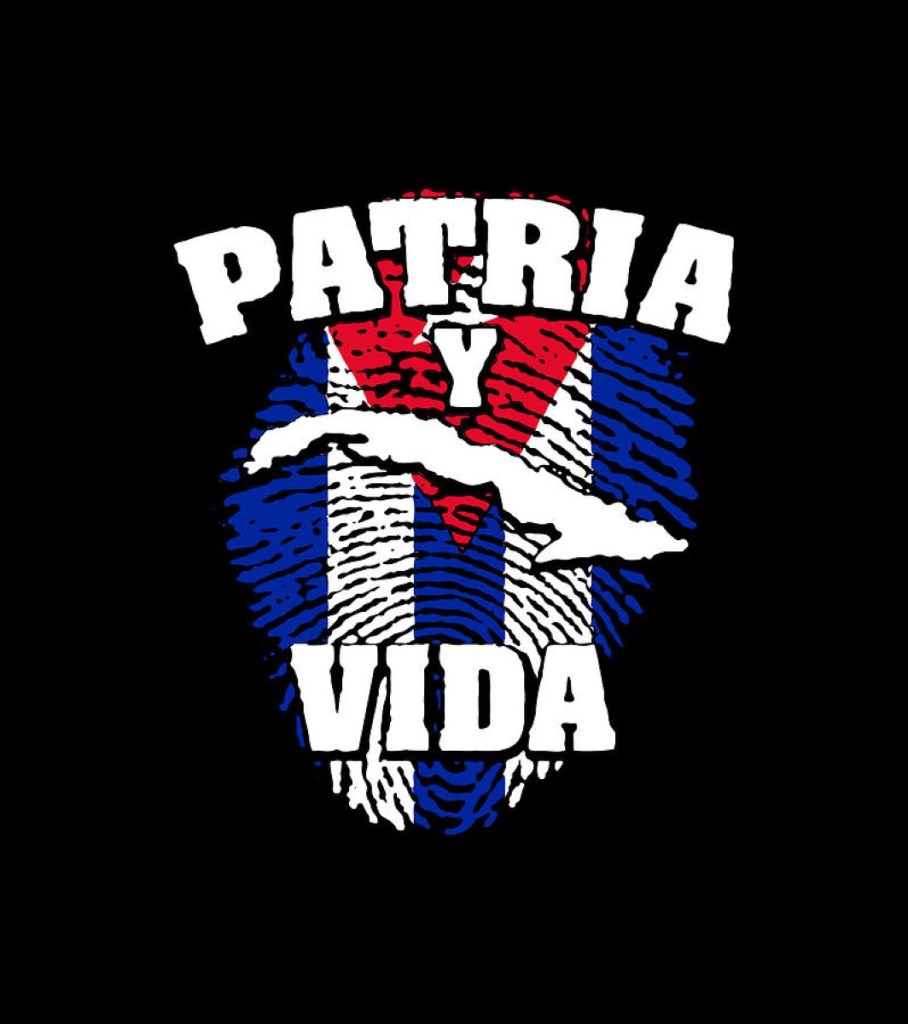
“Patria y Vida” or “Homeland and Life” – a protest song that became the anthem of the largest protest demonstrations in Cuba in 2021.
Written by Yotuel Romero, the group Gente de Zona, Descemer Bueno, Maykel Osorbo, Eliecer “el Funky“ Marquez Duany, and Beatriz Luengo (Yotuel’s wife), it won song of the year and best urban song at the 2021 Latin Grammy awards.
“Patria y Vida” is an inversion of the Communist Cuban slogan of “Patria o Muerte” — “Homeland or Death.”
There is a world of difference between the conjunctions “and” and “or” – between “y” and “o.” The latter symbolizes a my-way-or-the-highway mindset. Completely totalitarian. It leaves no room for individual thinking – typical of the communist ideology where the Communist Party is supreme. It is also delusional to think that Cubans would be willing to die for a homeland ruled for sixty-six years by a totalitarian regime that has denied them the most basic human rights.
On the other hand, “patria y vida” offers the option to aspire to a homeland where the dignity and prosperity of all citizens would be implemented – a homeland of, by, and all Cubans. A homeland where no one would be left behind.
Despite the bogus claim by Cuban authorities, racism is still prevalent in Cuban society. Yotuel recounts the following incident in Cuba: “Once I was walking down the street with Bea (Beatriz Luengo, who is white and a Spaniard) and they told her: Wow, you’ve set the race back.”
With the exception of Beatriz, the other composers of this song are all Afro-Cubans. But this did not stop the official website CubaDebate to label Yotuel a “jinetero” (“prostitute) for marrying Beatriz. Cuban Government sympathizers forget the basic fact that love has no racial barriers. Love is an emotion that triggers an unstoppable chemical reaction in the heart.
But this was not all. Back in 2020, an agent of the Castro regime wrote on social networks the following: “He [Yotuel] has reached where he has arrived thanks to Fidel and the Revolution without whom he would only have been a black shoeshine boy.”
Yotuel does not live in Cuba anymore for political reasons and dreams of returning only to a Cuba Libre. If the Cuban Revolution had taken Yotuel under its wings, there would have been no need for him to emigrate. Indeed, outside the Cuban Revolution, Yotuel is now a very successful musician with multiple awards under his belt. It is not inconceivable that if he had stayed in Communist Cuba, his destiny would have been nothing more than that of a “black shoeshine boy.” He found fame, a loving wife, and a society that rewarded talent and not race outside of Cuba.
The massive demonstrations on July 11, 2021, had its genesis in Decree 349 – a Cuban law enacted in 2018 that obligated artists to get advance permission for public and private exhibitions and performances. Government inspectors were authorized to confiscate the artwork of those breaking this law. In September 2018, a group of artists who went by the name of “San Isidro Movement” launched a protest against Decree 349. In February 2021, the song “Patria y Vida” was released. In April 2021, residents of the San Isidro neighborhood impeded the arrest of rapper Maykel Osorbo and chanted the song “Patria y Vida” and other anti-government slogans.
It was only a matter of time before things took a turn for the worst. July 11, 2021 saw the largest anti-government protests since 1994. Cubans denounced cultural censorship, food and medicine shortages (especially during the COVID pandemic), lack of basic human rights, the government’s hypocrisy regarding racial and socioeconomic equality, and the unfulfilled promises to bring about economic and political reforms. Cubans got tired of the communist charade and demanded a change. They dreamed of a country where they could prosper, grow, live, and vote in free elections for political candidates of their choice.
Rather than meeting with the leaders of the demonstrations, the Cuban government made hundred of arrests and charged many with crimes that included sedition. Maykel Osorbo was arrested in May 2021 and is currently serving a nine-year prison sentence.
The fact that one of the composers of this song, Maykel Osorbo, is serving a jail sentence because the Cuban authorities feared the emotions that it engendered demonstrates vividly the weakness of the Cuban Communist regime. Its sustainability is only possible by repression. A song being an existential threat to the Cuban authorities?!!! Laughable!
I am not a fan of rap, hip-hop, reggaeton, and cubaton music. To me, music entails harmony, and the latter genre lack it. Nevertheless, I do like the message that this song brings to the table. As a social protest to the dire conditions that Cubans have endured for over sixty years, where the average salary of a Cuban worker in 2025 is a meager $17, where there has been a 24% decline in the Cuban population during the last four years since 2024 due to massive mass migration (which puts the Cuban population at 8M), I stand firmly in solidarity with “Patria y Vida.”
The recent Cuban migration could be designated as a “reverse Pedro Pan Program.” The original “Pedro Pan Operation” was a clandestine exodus of over 14,000 unaccompanied Cuban minors ages 6 to 18 to the United States over a two-year span from 1960 to 1962 to save them from communist indoctrination. The current program differs from the original because it entails parents leaving their children with their parents or close relatives in Cuba because of the risks associated with sea and land crossings. The original program took children out of Cuba while the current one kept children in a communist country.
It easier for some people to capture the essence of a message or a story by reading a book. Others favor instant gratification and prefer getting information through a song. Others gravitate towards the visual arts to get informed.
It is because of the latter group that Beatriz Luengo memorialized the impact that her husband’s song had worldwide by producing a documentary. “Patria y Vida: The Power of Music” debuted in most AMC theaters in Florida on July 11, 2025. It is expected to be released in other areas of the U.S. shortly. The documentary lasts ninety minutes to symbolize the ninety miles that separate Key West from Havana.
The song and the documentary have united Cubans living in Cuba, Cuban-Americans, and Cubans throughout the world into one family wanting a change in their homeland for democracy and a free-market economy where everyone can move up the social scale based on his/her talents.
Patria y Vida, Venceremos! With the “Homeland and Vida” chant, we will attain Victory!
 Jorge E. Ponce