PATRIA Y VIDA / by Jorge E. Ponce

“Patria y Vida” or “Homeland and Life” – a protest song that became the anthem of the largest protest demonstrations in Cuba in 2021. 

Written by Yotuel Romero, the group Gente de Zona, Descemer Bueno, Maykel Osorbo, Eliecer “el Funky“ Marquez Duany,  and Beatriz Luengo (Yotuel’s wife), it won song of the year and best urban song at the 2021 Latin Grammy awards.  

“Patria y Vida” is an inversion of the Communist Cuban slogan of “Patria o Muerte” — “Homeland or Death.”

There is a world of difference between the conjunctions “and” and “or” – between “y” and “o.” The latter symbolizes a my-way-or-the-highway mindset.  Completely totalitarian.  It leaves no room for individual thinking – typical of the communist ideology where the Communist Party is supreme.  It is also delusional to think that Cubans would be willing to die for a homeland ruled for sixty-six years by a totalitarian regime that has denied them the most basic human rights. 

On the other hand, “patria y vida” offers the option to aspire to a homeland where the dignity and prosperity of all citizens would be implemented – a homeland of, by, and all Cubans.  A homeland where no one would be left behind.  

Despite the bogus claim by Cuban authorities, racism is still prevalent in Cuban society.  Yotuel recounts the following incident in Cuba: “Once I was walking down the street with Bea (Beatriz Luengo, who is white and a Spaniard) and they told her: Wow, you’ve set the race back.”  

With the exception of Beatriz, the other composers of this song are all Afro-Cubans.  But this did not stop the official website CubaDebate to label Yotuel a “jinetero” (“prostitute) for marrying Beatriz.  Cuban Government sympathizers forget the basic fact that love has no racial barriers.  Love is an emotion that triggers an unstoppable chemical reaction in the heart.

But this was not all.  Back in 2020, an agent of the Castro regime wrote on social networks the following: “He [Yotuel] has reached where he has arrived thanks to Fidel and the Revolution without whom he would only have been a black shoeshine boy.”

Yotuel does not live in Cuba anymore for political reasons and dreams of returning only to a Cuba Libre.  If the Cuban Revolution had taken Yotuel under its wings, there would have been no need for him to emigrate.  Indeed, outside the Cuban Revolution, Yotuel is now a very successful musician with multiple awards under his belt.  It is not inconceivable that if he had stayed in Communist Cuba, his destiny would have been nothing more than that of a “black shoeshine boy.” He found fame, a loving wife, and a society that rewarded talent and not race outside of Cuba.

The massive demonstrations on July 11, 2021, had its genesis in Decree 349 – a Cuban law enacted in 2018 that obligated artists to get advance permission for public and private exhibitions and performances.  Government inspectors were authorized to confiscate the artwork of those breaking this law.  In September 2018, a group of artists who went by the name of “San Isidro Movement” launched a protest against Decree 349.  In February 2021, the song “Patria y Vida” was released.  In April 2021, residents of the San Isidro neighborhood impeded the arrest of rapper Maykel Osorbo and chanted the song “Patria y Vida” and other anti-government slogans. 

It was only a matter of time before things took a turn for the worst.  July 11, 2021 saw the largest anti-government protests since 1994.  Cubans denounced cultural censorship, food and medicine shortages (especially during the COVID pandemic), lack of basic human rights, the government’s hypocrisy regarding racial and socioeconomic equality, and the unfulfilled promises to bring about economic and political reforms.  Cubans got tired of the communist charade and demanded a change.  They dreamed of a country where they could prosper, grow, live, and vote in free elections for political candidates of their choice. 

Rather than meeting with the leaders of the demonstrations, the Cuban government made hundred of arrests and charged many with crimes that included sedition.  Maykel Osorbo was arrested in May 2021 and is currently serving a nine-year prison sentence.   

The fact that one of the composers of this song, Maykel Osorbo, is serving a jail sentence because the Cuban authorities feared the emotions that it engendered demonstrates vividly the weakness of the Cuban Communist regime.  Its sustainability is only possible by repression.  A song being an existential threat to the Cuban authorities?!!! Laughable!

I am not a fan of rap, hip-hop, reggaeton, and cubaton music. To me, music entails harmony, and the latter genre lack it.  Nevertheless, I do like the message that this song brings to the table.  As a social protest to the dire conditions that Cubans have endured for over sixty years, where the average salary of a Cuban worker in 2025 is a meager $17, where there has been a 24% decline in the Cuban population during the last four years since 2024 due to massive mass migration (which puts the Cuban population at 8M), I stand firmly in solidarity with “Patria y Vida.”  

The recent Cuban migration could be designated as a “reverse Pedro Pan Program.”  The original “Pedro Pan Operation” was a clandestine exodus of over 14,000 unaccompanied Cuban minors ages 6 to 18 to the United States over a two-year span from 1960 to 1962 to save them from communist indoctrination.  The current program differs from the original because it entails parents leaving their children with their parents or close relatives in Cuba because of the risks associated with sea and land crossings. The original program took children out of Cuba while the current one kept children in a communist country. 

It easier for some people to capture the essence of a message or a story by reading a book.  Others favor instant gratification and prefer getting information through a song.  Others gravitate towards the visual arts to get informed. 

It is because of the latter group that Beatriz Luengo memorialized the impact that her husband’s song had worldwide by producing a documentary.  “Patria y Vida: The Power of Music” debuted in most AMC theaters in Florida on July 11, 2025. It is expected to be released in other areas of the U.S. shortly. The documentary lasts ninety minutes to symbolize the ninety miles that separate Key West from Havana.   

The song and the documentary have united Cubans living in Cuba, Cuban-Americans, and Cubans throughout the world into one family wanting a change in their homeland for democracy and a free-market economy where everyone can move up the social scale based on his/her talents. 

Patria y Vida, Venceremos! With the “Homeland and Vida” chant, we will attain Victory!

JORGE’S BOOK RE-ISSUED

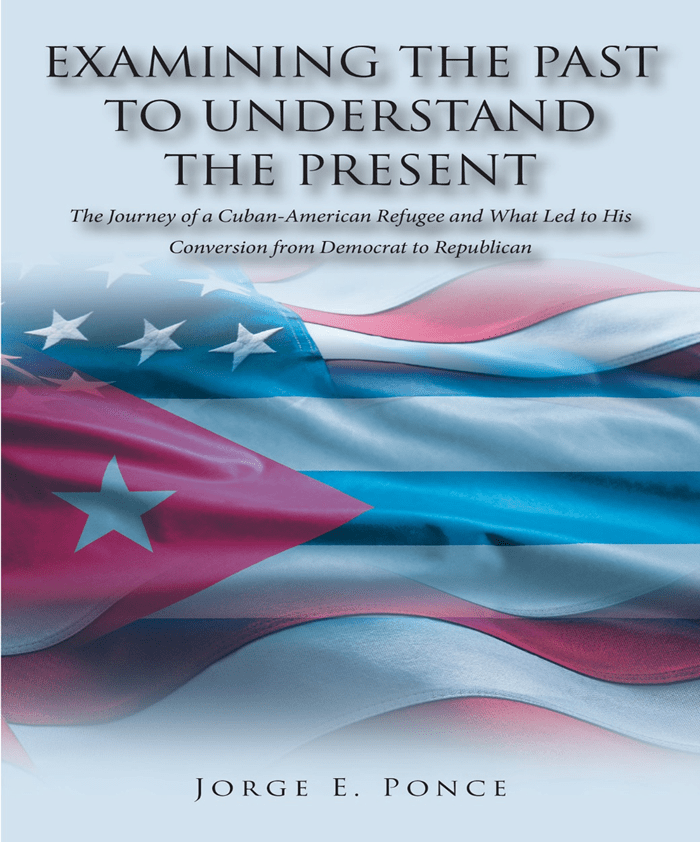
Author Jorge E. Ponce, a Cuban American who came to the United States with his family as political refugees via the Freedom Flights in 1966, has re-issued a new edition of his most recent book, “Examining the Past to Understand the Present: The Journey of a Cuban-American Refugee and What Led to His Conversion from Democrat to Republican”: a powerful memoir that follows the author through his immigration to America as a political refugee, and his eventual turn to the political right after years of disappointment from Democrats and witnessing the dangers of communism.

The new edition has additional articles and an updated/ expanded introduction.  The good news is that while this edition has more material, it also has a cheaper price tag.  More for less – an enviable combination for today’s consumers. 

Born in Havana, Cuba, Jorge grew up in Arlington, Virginia, and retired to the Sunshine State of Florida. He has used his pen prolifically to write his views about issues that needed to be aired so that others in the media and diverse communities got the other side of the story. The author’s letters to the editor have been published frequently in the Washington Post, the Washington Times, and the Tampa Bay Times. Ponce has worked for the Federal Government for his entire professional career and has received multiple awards for his civil rights work. Now that he’s enjoying his retirement, he considers himself lucky to be able to write about topics that move his soul.

“This book will be helpful to those who have made the decision to leave their homeland,” writes Jorge. “It will not be an easy transition at first. The younger you are when you become an immigrant or a refugee, the better you will be able to adapt to a different culture and language. But you must embrace a frame of mind that you are in a new country to assimilate into its culture; not to change it.  Achieving the American Dream proved that the journey was well worth it!

Jorge continues, “This book will also be helpful to politicians who wonder how to get and keep a big chunk of the Hispanic vote on their side, as well as those who wonder how they lost it. It will be an eye-opener to those who can’t figure out why it’s so difficult to get Cuban Americans to vote for Democrats. Past experience living an arduous life under a Communist regime leaves indelible scars about the Left that can never be erased.” More importantly, you’ll be able to assess this political transformation from the mouth of a Hispanic — not from someone who claims to know the Hispanic culture. The latter makes a big difference to establish authenticity.

Jorge’s book brings the challenges, disappointments, and victories that destiny threw in his path to the forefront, revealing all the events that shaped him and his views on the nation’s political climate. Thought-provoking and deeply personal, Jorge provides answers to the ultimate questions of why the recent exodus of Hispanics to the Republican Party has taken place and the urgent need to keep this group in their tent to win future elections.

Parts 1-4 narrate Jorge’s life story in Cuba BC (Before Castro), Cuba AC (After Castro), United States, and his retirement in Florida.  After learning Ponce’s life history in the previous parts, Part 5 has sixty-seven articles on a myriad of subjects that have moved Jorge’s soul deeply ranging from politics, philosophy, religion, civil rights, Hispanics, and Cuban Americans. It is in Part 5 that Jorge discusses the reasons that led him to his conservative switch.  

Readers who wish to experience this enlightening work can purchase this book on the Amazon.com portal in multiple editions: hardback, paperback, and Kindle here.

Examining The Past To Understand The Present / Jorge E. Ponce

Some friends have expressed disillusionment at the disrespect that the United States has received lately from dictators, terrorist groups, free-speech detractors, and theocratic mullahs.  Most attribute this malaise to the weak foreign policies of former President Joe Biden. 

Other friends are outraged at the Biden’s economy where most Americans could hardly make ends meet because of inflation.  Despite all the feel-good, make-belief propaganda disseminated by Biden’s acolytes, Americans confronted reality when they went to pump gas for their cars, when they bought groceries at the supermarket, when they went out for lunch or dinner at a restaurant that had reasonable prices for their menu entrees in the past, when they purchased airfares for a needed vacation, when they went out to buy or lease a car, when they wanted to buy a house and the interest rates for a mortgage approached 8% – basically, when they bought any services that were affordable when President Trump occupied the Oval Office and which have started to improve under his second term.

Hispanics are the latest group to say that they’ve had enough with the failed policies of Democrats.  But this presents an “inconvenient truth” to the liberal cabal.  To discredit this switchover, they have called conservative Cuban-Americans all kinds of pejoratives – Batista sympathizers, inveterate hardliners, cavemen, reactionaries, Miami Mafia, and unauthentic Hispanics.  I’ve addressed the truth about Cuban-Americans by writing an article in my book.

Moreover, Hispanics realize instantly when politicians are only interested in their vote and not on their issues of concern.  When First Lady Jill Biden gave a speech in San Antonio, Texas and tried to ingratiate herself with Hispanic voters, she called them “breakfast tacos.” When Biden addressed a gathering of the Congressional Hispanic Caucus during the 2023 Hispanic Heritage Month, he mistook it for the Congressional Black Caucus. And some in the Democrat cabal have done the unthinkable when it comes to the Spanish language – they want to make it gender-neutral by using the term “LatinX.” Democrats ignore the basic fact that Latinos and Latinas will vote for politicians who have their backs.

It is smart when politicians learn directly from Hispanics what motivates them to vote and who resonates with their aspirations and values.  Hispanics do not react well when non-Hispanic politicians attempt to speak for them. 

Many Americans are ready to hang up their hats and say that the era of reaching the American Dream and attaining life, liberty, and the pursuit of happiness is over. I ask them a simple question: what have you done lately to restore freedom and democracy to the country that we all love?!!! Let the road to recovery begin with you!

It is precisely when answering my own question that I tell others what I have done lately for my country. I spent a year writing the book – and editing it with my wife’s help – “Examining the Past to Understand the Present – The Journey of a Cuba-American Refugee and What Led to His Conversion from Democrat to Republican.”

The book will be helpful to those “legal” immigrants and political refugees who have made the decision to leave their homeland. I narrate my life story in Cuba and the United States in parts 1-4 of my book.

Although the book has over sixty of my articles on many subjects ranging from politics, philosophy, civil rights, religion, Hispanics, and Cuban-Americans in part 5 of my book, I do dwell on my transformation from a Democrat to a Republican and what led up to it. I tell past friends who got annoyed with my conversion that life is a journey that cause us to learn new things, and that changes how we view the world.

But the challenge that I’ve faced is to market the book in conservative and Hispanic networks.  The conservative ones have ignored my interview requests because I’m not a public figure like the ones who publish books regularly on the Fox News network.  The Hispanic ones don’t want to hear from me because they think that my book message is antithetical to their leftist ideology. 

Make a difference.  Buy my book.  Write a review. Help out a conservative who contributed his grain of sand to “Make America Great Again!”

Meet Jorge and Siomara Ponce

Jorge and Siomara Ponce live in The Champions’ Club in Trinity and are both Cuban-Americans.  After living most of their lives in Northern Virginia, they moved to Florida in the spring of 2014 after growing tired of their long work commutes to Washington DC from their suburban home and the cold weather, especially shoveling snow and raking leaves. 

Jorge worked for the Federal Government his entire professional career.  While a bureaucrat, he did not live his life as one.  He considers himself a fiscal conservative with a social conscience.  He has received multiple awards for his civil rights work in the past.  Now that he has retired, he keeps himself busy by writing articles with no filters on important issues. Siomara, on the other hand, worked in the corporate private sector in the area of human resources — for an international management consulting firm and an emerging markets private equity firm.

Although most people question why they would not prefer living in Miami in their retirement – as it is considered the Cuban Mecca in the U.S. – it was never an option for them as Miami is too congested and hectic.  They were seeking a laid-back community where peace was prevalent and yet someplace close enough to drive to Miami to visit family and enjoy their favorite Cuban food and music whenever they wanted.

In addition to these visits to Miami and to the Washington, DC Metropolitan Area to spend time with their son, daughter-in-law, two granddaughters, and lifelong friends, they take at least two extended trips annually.  They’ve traveled to Mexico, Panama, Germany, Ireland, France, Italy, Greece, the Greek Islands, Turkey, and Spain.  They love all the places that they’ve visited, but Italy remains the one country that speaks to their souls.  It has everything they enjoy the most — beautiful music, history, civilization, scenery, delicious food, and, most importantly, wonderful people who love to live life to the fullest and enjoy sharing their zest for living with others. The feeling is certainly contagious!!

Most recently they traveled to Spain on a 17-day vacation — although Jorge admits he did not necessarily want to go.  He only agreed after Siomara said she was going, “with or without him.” From a historical perspective, and as a Cuban-American who is very nationalistic, he always resented the killing of Cuban patriots like Martí, Maceo, Céspedes, and Agramonte when Cuba fought its War of Independence against Spain in the 19th century.   This goes back in history, he acknowledges that.  But in the 20th and 21st centuries, Spain has been one of the European countries that has invested heavily in Communist Cuba – business ventures that help prolong the suffering of Cubans and which are accessible only to those with foreign currencies. Considering his position and life experiences regarding Cuba, he had difficulties with the idea. It didn’t take him much time to acknowledge what a fabulous time they were having and to have followed Siomara’s “not so subtle encouragement.”

Jorge is passionate about writing and reading — and these passions led him to complete his book, “Examining the Past to Understand the Present: The Journey of a Cuban-American Refugee and What Led to His Conversion from Democrat to Republican.” This is a powerful memoir that follows the author through his immigration to America as a political refugee and his eventual turn to the political right after years of witnessing the embrace of many socialist policies by Democrats. Jorge’s book is available in hardcopy, paperback, and Kindle editions on multiple online portals like Amazon. Siomara played a pivotal role in editing Jorge’s book – as attention to detail is one of her strengths.

Jorge had multiple influences that led him to write the book.  He is a great admirer of the late political commentator Charles Krauthammer and loved one of his books (“Things That Matter”).  He was also mindful of Cuban National Hero José Martí’s quote: “there are three things that every man should do in his life: plant a tree, have a son, and write a book.” While Martí said these words in the 19th century, Jorge would update the quote to highlight the importance of being a parent to either a son or a daughter.  Having said this, the only thing that remained to emulate Martí’s message was to write a book.  Now, he’s in full compliance.

Jorge realizes how important Hispanics have become in the political circles in the United States.  He also recognizes the wisdom of past civil rights champions like Dr. Martin Luther King, Jr., in fighting discrimination by advocating the judging of all Americans by the “content of their character and not by the color of their skin.”  He firmly believes how important it is to reach a colorblind society to treat every American – without leaving anyone out – with the dignity and respect that every human being deserves. 

Jorge’s book also offers a shining light to legal immigrants who are navigating a new life in a new country with a different culture and language.  While there are many challenges to be faced, America is the best country in the world to bring prosperity to those who work hard and pull themselves up by their bootstraps.  This is Jorge’s story.  This is the story that he narrates in his book.

Jorge’s hobbies include good music (excluding reggaeton and rap), reading, travel, wine tastings, and enjoying the simple pleasures of life – a necessary thing to keep your sanity in a metropolitan area like the one in Washington, DC that desires to measure everything. He says that so many never learn that the things that really count are not countable!

Upon retiring, he found peace in himself when he accepted the fact that what really mattered at work was the difference that he had made in the lives of others.  He also gives thanks to his God for walking out unharmed through the many land mines that he was exposed to through the years. Many of his colleagues were not so lucky. He stated that upon his retirement, he walked out the door with his credibility intact, with his head held high, with the ability to look everyone straight in the eyes and enter through the front door. He left the workforce full of hope for each tomorrow.

Most importantly, Jorge embraced the urgency of enjoying those precious “momentos” with his immediate family and close friends—to show them by his deeds that they were the reason for attaining fulfillment in the autumn of his days, and to tell them that he did these things because they made him feel like a useful and happy man, and not because of the accolades, fancy titles, monetary benefits that others cherish.

Jorge and Siomara wanted to share this message with their neighbors. The world will be a better place when we cherish the time that we are all granted by God to make a positive difference in each other. There is not a precious moment to waste. Our God grants us a beginning and an end. What comes in between is a gift, a hyphen, and it’s up to each of us what we make of it!

They are in pretty good company when underscoring what counts in life. Alexander the Great, King of Macedonia and conqueror of the Persian Empire, stated before his death: “We do not take to our grave any material wealth. Time is our most precious treasure because it is limited. We can produce more wealth, but we cannot produce more time.”